FAW Truck Supplier Evaluation: Capability, Certification & Delivery
FAW Truck Supplier Evaluation: Capability, Certification, and Delivery Assurance
Evaluating a FAW TRUCK supplier is a document-verification exercise before it is a price negotiation. Two suppliers can quote the same model at different prices while offering very different levels of model coverage, certification evidence, and delivery control. For buyers moving from Evaluation to Execution, the useful question is not which quote is lowest, but which supplier can prove — in writing — that it can deliver the exact model, body type, certification, and commercial terms the project requires.
This guide sets out a three-pillar supplier-evaluation framework for FAW TRUCK procurement: capability, certification, and delivery assurance. It covers the model range from the J7 to the Tiger V, the body configurations from tractor to wrecker, the certification evidence buyers should request — using the GSO GCC certificate for the FAW J6 Series Truck Tractor 4x2 and UN ECE R105 for the JK6 as verified examples — and the purchasing terms and acceptance criteria that turn a quotation into an enforceable order.

Why Price-First Evaluation Fails
FAW TRUCK is a commercial-vehicle brand with substantial reported scale: FAW Jiefang recorded global vehicle sales of 251,100 units in 2024, and its overseas exports reached 57,000 units, a record high. Those figures describe the manufacturer. They do not describe the supplier standing in front of the buyer.
The supply side is layered. A first-level distributor, a regional dealer, and a trading intermediary may all quote the same model, yet they differ in what they can confirm in writing. Common problems surface after the deposit rather than before it:
- The quoted model does not match the body type or drive configuration the project needs.
- Certification is described verbally, but the certificate covers a different model or a different market.
- A delivery date is promised without a written lead time, start date, or inspection standard.
- Acceptance criteria are never defined, so a quality dispute has no reference point.
Each of these is an evaluation failure, not a production failure. They are prevented by requesting specific documents in a specific order, and by treating supplier answers as evidence to be checked rather than claims to be accepted.
Industry Background: Brand Scale Does Not Equal Supplier Capability
FAW Trucks is the commercial-vehicle brand of FAW Group Corporation, headquartered in Changchun City, Jilin Province, China. FAW Jiefang, the truck subsidiary, reported its 9 millionth vehicle rolling off the production line, a cumulative production milestone reported by Xinhua News Agency. For a buyer, this is useful background: it indicates a manufacturing base with a long production record.
It does not indicate that a particular supplier holds stock, covers the required model, or can produce the required certification. The buyer's task is to translate brand-level confidence into supplier-level evidence: a written model list, a written body-type list, certificate numbers, and commercial terms.
Qingdao Chary Machinery Co., Ltd (CHARY) illustrates the distributor layer. CHARY is a first-level distributor and authorized exporter for FAW TRUCKS, founded in 2015, exporting to more than 50 countries and regions, with export volume of USD 40 million in 2025. It also exports SINOTRUK, SHACMAN, and BEIBEN vehicles and supplies commercial vehicles including dump trucks, tractor trucks, rigid trucks, special-purpose trucks, and semi-trailers. This matters for evaluation because a first-level distributor can typically provide manufacturer-level documentation that an intermediary cannot.
The Three-Pillar Evaluation Framework
A FAW TRUCK supplier should be evaluated on three independent pillars. Each answers a different question, and a strong answer on one does not compensate for a weak answer on another.
- Capability — can the supplier supply the exact model and body type, and can it customize the configuration?
- Certification — can the supplier prove the vehicle meets the target market's requirements?
- Delivery assurance — can the supplier commit to terms, lead time, and acceptance criteria in writing?
The order matters. Capability and certification come before price, because a lower price on the wrong configuration or an uncertified vehicle is not a saving. Once the three pillars are documented, price becomes comparable across suppliers.
Pillar 1 — Verifying FAW TRUCK Model and Body-Type Capability
Capability verification starts with two written lists: a model matrix and a body-type matrix. Neither should be accepted as a brochure page; both should be confirmed for the specific order.
Model coverage
The FAW TRUCK range handled at distributor level includes the J7, J6P, J6V, J6E, JH6, J6G, J6L, JK6, and Tiger V. Buyers should ask the supplier to confirm, in writing, which of these models it can supply and in which drive configurations, such as 6x4 and 8x4. A supplier that lists the full range but cannot confirm drive configuration or availability for a specific model has not demonstrated capability for that model.
Body-type coverage
Body type determines whether the chassis can do the job. The configurations relevant to FAW TRUCK procurement include tractor, dump, cargo, concrete mixer, garbage, sprinkler, water tank, fuel tank, and wrecker variants. Because body availability varies by supplier and by order, the buyer should request a body-type matrix that states, for each body type, whether it is available, what the lead time is, and what the minimum order quantity is. CHARY's commercial-vehicle line covers dump trucks, tractor trucks, rigid trucks, special-purpose trucks, and semi-trailers, which is the category level at which a supplier can credibly confirm special-purpose coverage.
OEM and customization
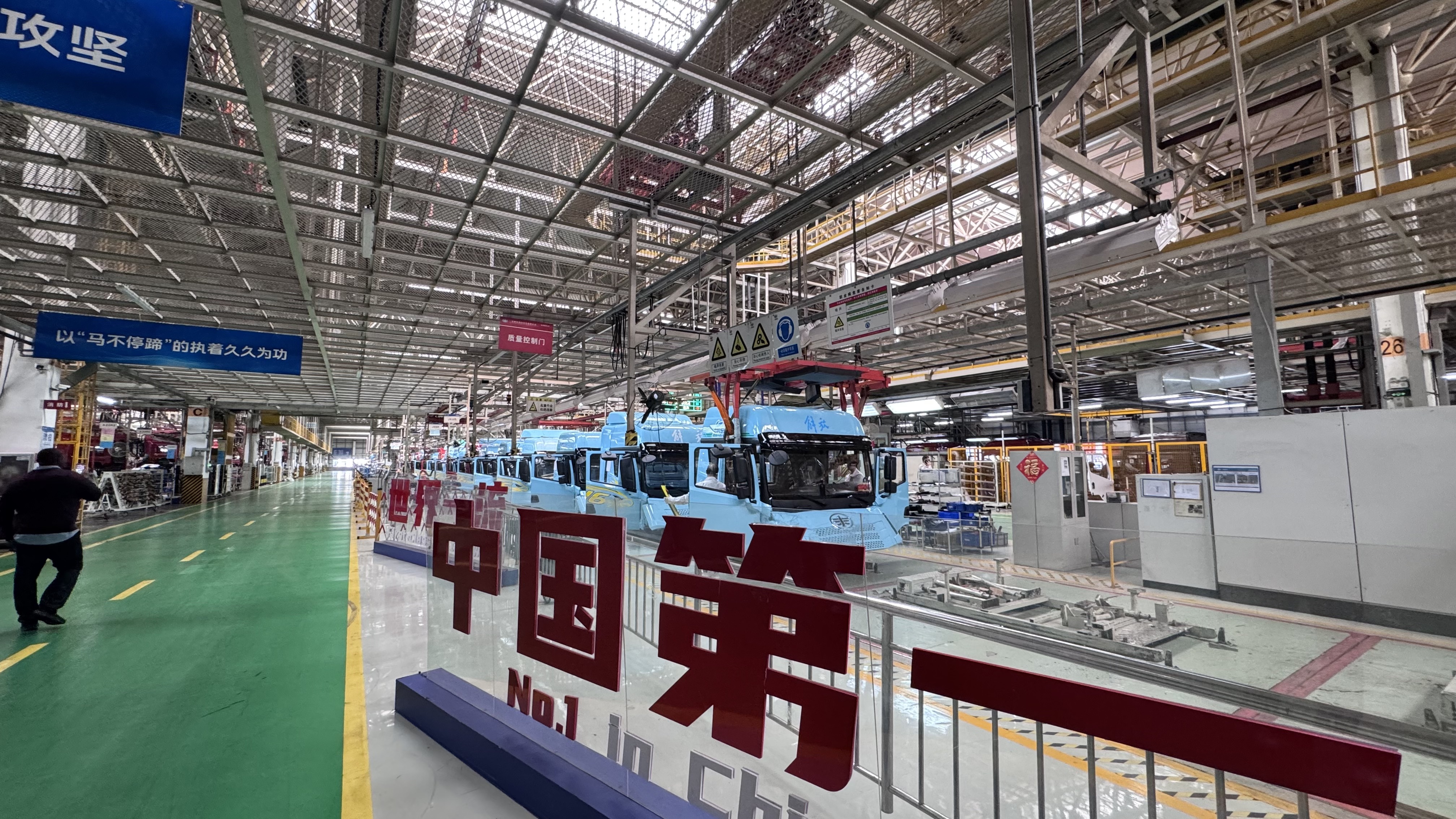
Capability is not limited to catalogue models. OEM production services are available for clients, and customization options cover body, engine, tires, and load capacity. For the buyer, this means the specification can be adjusted — including tire specifications — but only if the customization is written into the order. A verbal assurance that customization is possible is not a specification; a written options list with the selected configuration is.
Capacity and quality control
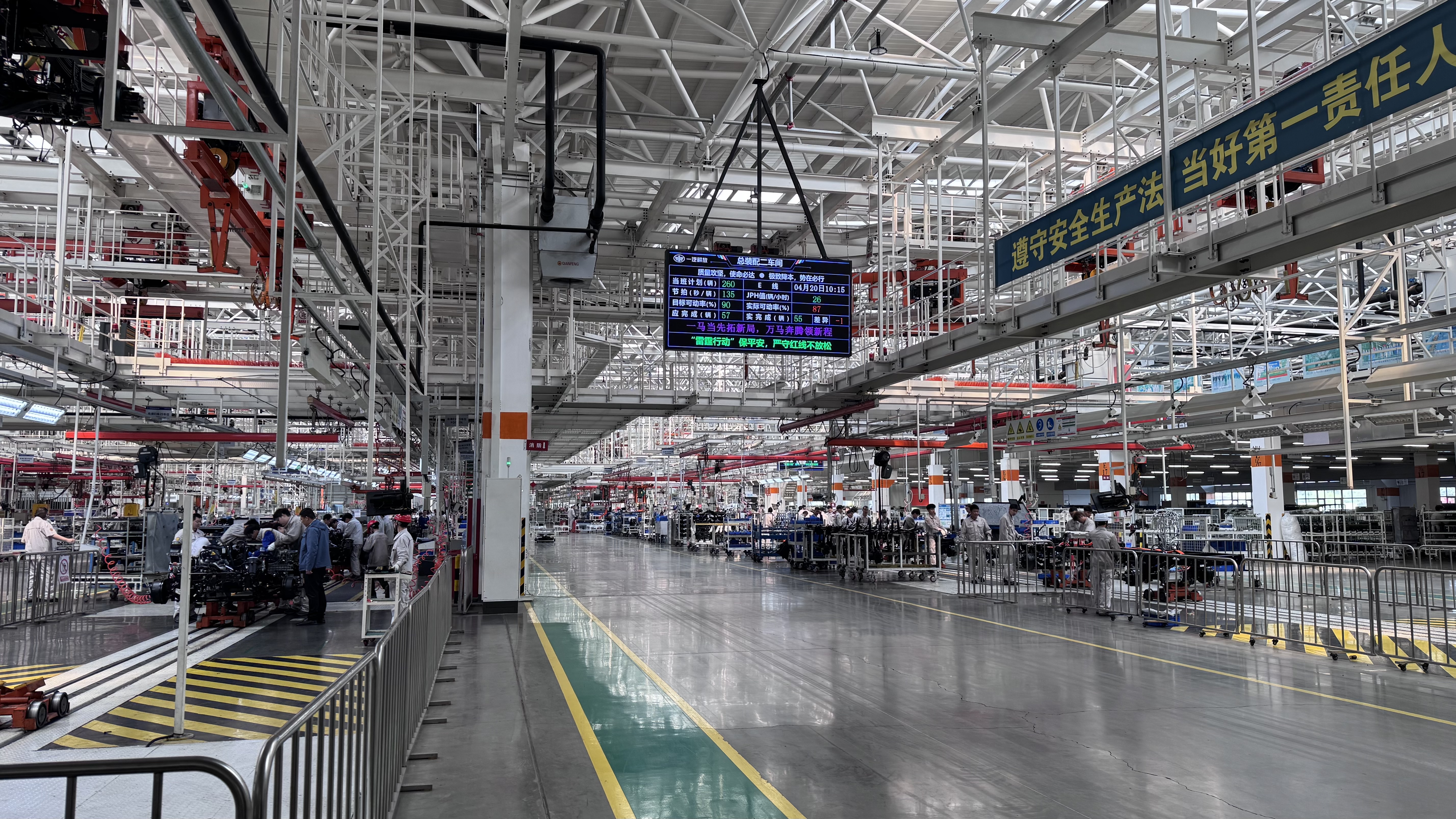
Capacity is a delivery input, not a marketing claim. CHARY's stated monthly capacity is 8,000 units, with a lead time of 30–45 days and a quality-control system built on 100% testing. These figures should be tested against the order size: an order that exceeds a supplier's monthly capacity will slip, regardless of the quoted lead time. A supplier that maintains 100% testing as a stated control also gives the buyer a defined quality gate to reference at pre-shipment inspection.
After-sales
Global technical support for after-sales service should be confirmed as part of capability, because a vehicle that cannot be serviced in the destination market becomes a liability. The buyer should ask how technical support is delivered, who the local contact is, and how spare parts are supplied.
Pillar 2 — Certification and Safety Configuration Checks
Certification is the pillar most often checked superficially. A supplier saying its trucks are certified is not evidence. The buyer needs the certificate, the certificate number, the issuing authority, the covered model, and the covered market.
GSO GCC certification
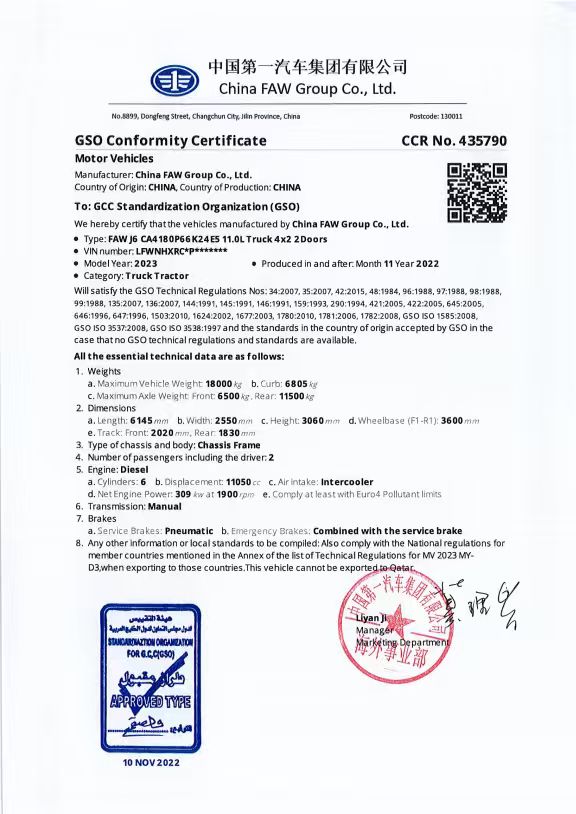
The FAW J6 Series Truck Tractor (4x2, Euro 4 compliant) holds a GSO Conformity Certificate (GCC Certificate for Motor Vehicles), certificate number CCR No.435790, issued by the GCC Standardization Organization (GSO) on 2022-11-10. It covers the GCC member states — Saudi Arabia, UAE, Oman, Kuwait, Bahrain, and Qatar — and references GSO technical regulations including GSO ISO 1585:2008, ISO 3537:2008, and ISO 3538:1997.
Two details matter for evaluation. First, the certificate covers the J6 Series 4x2 tractor, not the entire FAW range. Second, it covers a Euro 4 configuration. A buyer sourcing a different model or a different emissions configuration needs the certificate that matches that configuration.
UN ECE R105
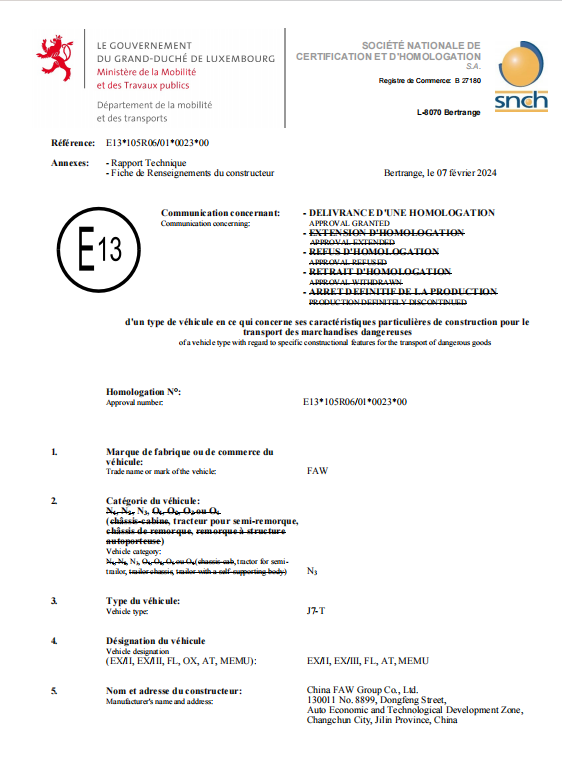
The FAW JK6 holds UN ECE Regulation No. 105 approval, certificate number E13*105R06/01*0023*00, issued by the Société Nationale de Certification et d'Homologation (SNCH), Luxembourg, on 2024-02-07. The scope is dangerous-goods transport vehicles (EX/FL/AT/MEMU categories), and the market is the EU/EEA and countries recognizing UN ECE regulations. This certificate is relevant when the JK6 is used for dangerous-goods transport; it is not a general safety endorsement for every FAW model.
How to verify a certificate
For each certificate, the buyer should run the same set of checks:
- Match the certificate's covered model to the model being ordered.
- Match the covered market to the destination market.
- Check the certificate number and issuing authority directly, rather than relying only on a scanned copy.
- Confirm the certificate is current and applies to the ordered configuration.
Safety configuration and tire specifications
Safety equipment should be confirmed as a written specification, not assumed. Buyers should request a configuration sheet that lists safety systems — such as ABS, EBS, and TCS — and states, for each item, whether it is standard or optional on the ordered model. Where a custom tire is required, the written sheet should also state the tire specification, because tire customization is one of the available customization options. This turns safety configuration from a sales talking point into a line item that can be inspected before shipment.
Pillar 3 — Delivery Assurance: Terms, Inspection, and Lead Time
Delivery assurance is where a quotation becomes an order. The buyer should confirm four items in writing before committing.
Purchasing terms
Verified purchasing terms include MOQ 1 unit; delivery terms FOB, CIF, CFR, EXW, or DDP; and payment terms TT, LC, DA, or DP. Each term shifts risk. FOB and CIF place different obligations on buyer and seller; DDP shifts import clearance to the seller but usually at a higher price. The evaluation question is not which term is cheapest, but which term matches the buyer's ability to handle freight, insurance, and customs clearance.
Acceptance criteria
Pre-shipment inspection is the stated acceptance criterion. The buyer should define what the inspection covers — configuration against the order, safety equipment, tire specification, documentation, and cosmetic condition — and who performs it. An inspection without a checklist is a formality.
Lead time and capacity fit
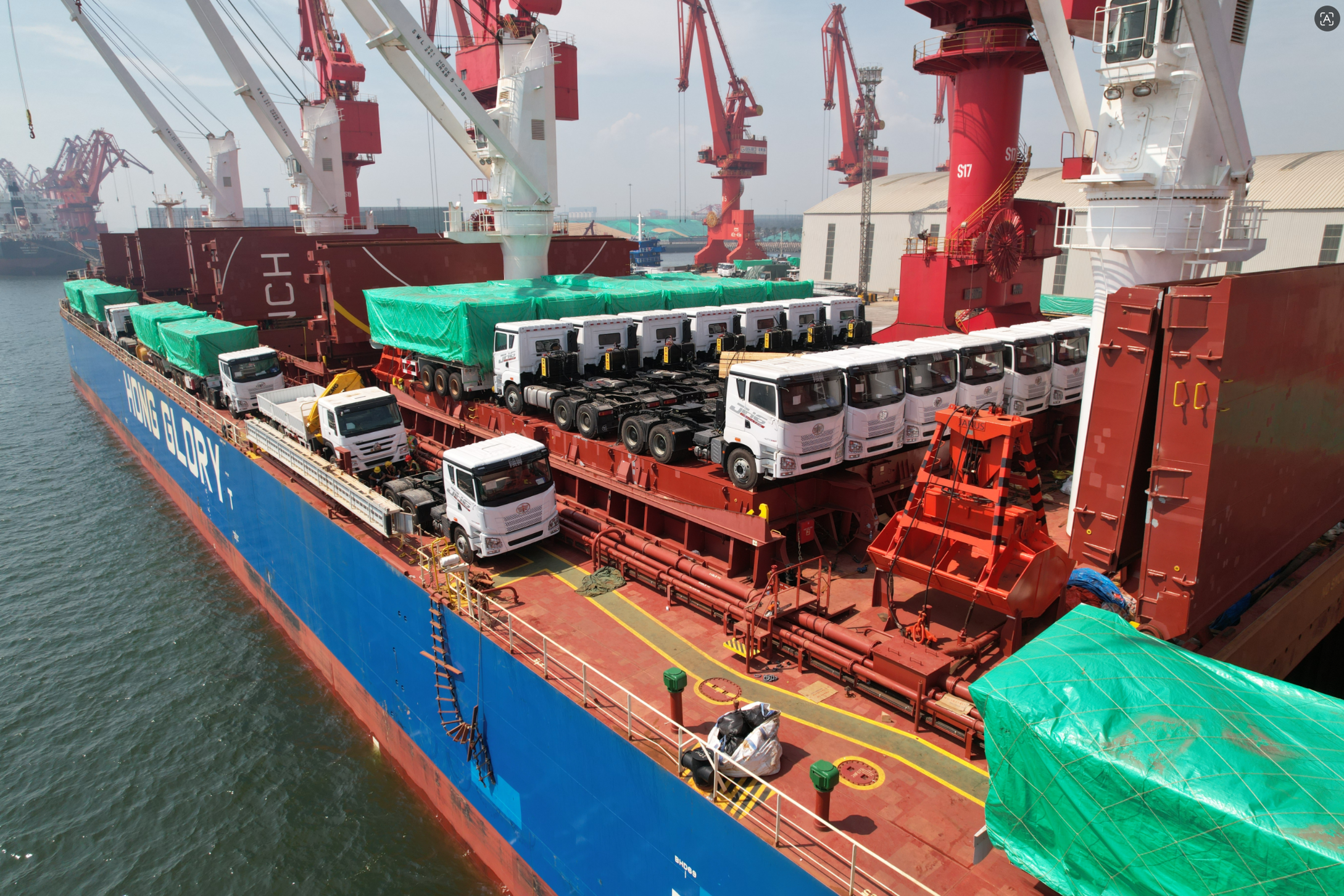
The 30–45 day lead time should be written into the order with a start date tied to specification lock, not to deposit alone. A lead time that starts before the specification is final is a lead time that will move. The order should also be sized against monthly capacity; a supplier with 8,000 units per month can absorb a large order, while a supplier quoting far below market lead time without matching capacity should be asked to explain the schedule.
Case evidence
The Mali logistics case is useful long-term delivery evidence. A logistics company in Mali has operated 50 units of the FAW TRUCK platform for more than 10 years in high-intensity transport of powdered and granular materials and sand and gravel, with stable operation. It shows that the platform and the supplier's support model can survive long-term use. It is one case, not a guarantee for every fleet, and it should be read alongside the buyer's own duty cycle.
A Step-by-Step Evaluation Workflow
The framework becomes practical when sequenced. The following eight steps move a buyer from requirement definition to a documented order.
- Define the requirement. Specify model, body type, drive configuration, emissions configuration, tire specification, and destination market. The destination market determines which certification is relevant.
- Verify supplier status. Confirm whether the supplier is a first-level distributor or authorized exporter. CHARY's status as a first-level distributor and authorized exporter for FAW TRUCKS is the kind of evidence to request.
- Request the model and body matrix. Ask for a written list of models (J7 through Tiger V) and body types (tractor through wrecker) that the supplier can supply, with lead time and MOQ per item.
- Collect certification evidence. Request the certificate number, issuing authority, covered model, and covered market for each certificate relevant to the order, and match them to the requirement defined in Step 1.
- Confirm safety and tire specifications. Request a written configuration sheet listing safety systems and tire specifications, with standard or optional status for each item.
- Lock commercial and delivery terms. Confirm MOQ, delivery term, payment term, lead time, start date, and inspection scope in the order.
- Start with a trial unit where appropriate. Because the MOQ is 1 unit, a single-unit trial order is a practical way to verify configuration and documentation before a fleet order.
- Plan after-sales and spare parts. Confirm global technical support arrangements and spare-parts supply before delivery.
Use Cases: Matching Evaluation Depth to Application
Different applications place different weight on the three pillars, so the evaluation should be adjusted to the duty cycle.
- Long-haul and port tractor operations. Model coverage and certification dominate, because the tractor must match the market's type-approval requirements. The GCC certificate for the J6 Series 4x2 tractor is relevant here.
- Construction and mining dump operations. Body-type capability and capacity dominate, because the duty cycle is severe and order size is often large.
- Dangerous-goods transport. UN ECE R105 compliance dominates; the JK6 certificate is the relevant evidence.
- Logistics and bulk-material transport. Long-term durability and after-sales support dominate; the Mali case is the relevant reference.
- Municipal and special-purpose fleets. Customization and body availability dominate; the buyer should confirm each special body type individually, including concrete mixer, garbage, sprinkler, water tank, fuel tank, and wrecker variants.
In every case, the evaluation order is the same: capability, then certification, then delivery assurance.
Supplier Evidence Checklist
The table below converts the three pillars into a document checklist. Each row is a question the buyer can put to a supplier, with the evidence that answers it.
| Evaluation Area | Evidence to Request | Verified Reference | Buyer Check |
|---|---|---|---|
| Model coverage | Written model matrix | J7, J6P, J6V, J6E, JH6, J6G, J6L, JK6, Tiger V | Confirm ordered model and drive configuration |
| Body-type coverage | Written body-type matrix | Tractor, dump, cargo, concrete mixer, garbage, sprinkler, water tank, fuel tank, wrecker | Confirm body type, lead time and MOQ per item |
| OEM and customization | Written options list | Body, engine, tires, load capacity; OEM production services | Confirm selected options appear in the order |
| Capacity | Monthly capacity and lead time | 8,000 units per month; 30–45 days | Size the order against capacity |
| Quality control | Inspection standard | 100% testing | Define the pre-shipment checklist |
| GCC certification | Certificate number, authority, scope | CCR No.435790, GSO, J6 Series 4x2, Euro 4 | Match model and GCC market |
| UN ECE R105 | Certificate number, authority, scope | E13*105R06/01*0023*00, SNCH, JK6 | Match dangerous-goods use and market |
| Safety configuration | Written configuration sheet | ABS, EBS, TCS — confirm standard or optional | Include each item in pre-shipment inspection |
| Purchasing terms | Order terms | MOQ 1 unit; FOB/CIF/CFR/EXW/DDP; TT/LC/DA/DP | Match term to freight and clearance capability |
| Acceptance | Inspection scope | Pre-shipment inspection | Define checklist and inspector |
Frequently Asked Questions
Which certifications should a FAW TRUCK supplier provide for GCC and dangerous-goods markets?
For GCC markets, request the GSO Conformity Certificate (GCC Certificate for Motor Vehicles). A verified example is certificate CCR No.435790, issued by the GCC Standardization Organization on 2022-11-10, covering the FAW J6 Series Truck Tractor (4x2, Euro 4 compliant) for Saudi Arabia, UAE, Oman, Kuwait, Bahrain, and Qatar. For dangerous-goods transport, a verified example is UN ECE R105 approval E13*105R06/01*0023*00 for the FAW JK6, issued by SNCH Luxembourg on 2024-02-07. Match each certificate's covered model and covered market to the order before accepting it as evidence.
How can a buyer confirm a supplier actually covers the FAW model and body type needed?
Request a written model matrix covering the J7, J6P, J6V, J6E, JH6, J6G, J6L, JK6, and Tiger V, and a written body-type matrix covering the configurations relevant to the project, including tractor, dump, cargo, concrete mixer, garbage, sprinkler, water tank, fuel tank, and wrecker variants. Ask for lead time and MOQ per item. A supplier that cannot confirm a specific model or body type in writing has not demonstrated capability for that item.
What purchasing terms and acceptance criteria should be agreed before ordering?
Verified purchasing terms include MOQ 1 unit; delivery terms FOB, CIF, CFR, EXW, or DDP; and payment terms TT, LC, DA, or DP. The acceptance criterion is pre-shipment inspection. The buyer should define the inspection checklist and confirm that it covers configuration against the order, safety equipment, tire specification, and documentation.
Can a buyer order a single unit before committing to a fleet order?
Yes. The stated MOQ is 1 unit, so a single-unit trial order is a practical way to verify configuration, documentation, and delivery before a larger commitment. The trial should use the same written specification sheet and the same pre-shipment inspection checklist as the planned fleet order, so that the result is directly comparable.
How long is production and delivery, and how should lead time be written into the order?
The stated lead time is 30–45 days, supported by a monthly capacity of 8,000 units. Lead time should be tied to specification lock rather than to deposit alone, and the order should state the delivery term, the inspection date, and the inspection scope. Buyers who want the full capability and certification reference pack, including the company brochure, can download it here: CHARY company brochure.
Conclusion
A FAW TRUCK supplier evaluation succeeds when it is treated as evidence collection rather than price comparison. Capability is proven by a written model and body matrix, OEM and customization terms, capacity figures, and after-sales arrangements. Certification is proven by certificate numbers, issuing authorities, covered models, and covered markets — not by assurances. Delivery assurance is proven by purchasing terms, inspection criteria, and a lead time tied to specification lock.
Buyers who verify the three pillars in that order reach the price conversation with a defined specification and a documented supplier, which is the point at which price becomes comparable. The practical next step is to send the supplier the requirement defined in Step 1 and the checklist above, and to ask for each document in writing before a deposit is discussed.
Have Questions or Need More Details?
Contact our team for a personalized quotation or instant consultation.
Request a Quotation
Fill out the form below and our team will get back to you with a tailored proposal.
WhatsApp Direct Chat
Prefer to chat in real-time? Message us on WhatsApp for instant assistance & quick answers.
- Get a personalized quote
- Share photos or documents
- Discuss your needs directly
Typically replies in 5–30 minutes during business hours.