
Head-to-Head: FAW J6P Dump Truck vs. FAW J6P Tractor Truck for Mining and Port Logistics

The FAW J6P is one model designation that can be built into very different working vehicles. Ordered as a FAW dump truck, it carries and discharges bulk material itself. Ordered as a FAW tractor truck, it pulls a semi-trailer and moves freight, containers or liquid cargo. For mining and port logistics, that single choice — integrated body or towing unit — decides how the truck earns money, how it is maintained, and how it is specified at the quotation stage.
This head-to-head compares the two configurations using verified FAW product facts, then sets out the decision sequence a fleet buyer should follow before signing a purchase order.
Answer first: if the cargo must be loaded, tipped and discharged inside a mine, quarry, construction site or materials yard, specify the FAW J6P as a dump truck. If the cargo moves inside a container, on a flatbed or in a tank trailer across port roads, highways and distribution corridors, specify the FAW J6P as a tractor truck. Both configurations sit inside the same FAW TRUCK product family and share published weight, dimension, material and safety parameters — including a 3000–15000 kg weight range, 6000×2300×3000 mm to 12000×2550×3800 mm overall dimensions, steel, iron, aluminum alloy and plastic construction, and ABS, EBS and TCS safety configuration.
What the Dump Truck vs. Tractor Truck Decision Actually Asks
The question is not which J6P is “better.” Both are heavy-duty commercial vehicle configurations built from the same published FAW model family. The question is which one matches the physical job.
Fleet buyers in mining and port operations usually discover this the hard way. A tractor truck ordered for a coal yard has nothing to tip. A dump truck ordered for container movement has no trailer to pull and no fifth-wheel coupling. The mismatch is not a specification error that can be corrected by a different tire or a larger fuel tank — it is a body-type error, and it is expensive.
Three buyer questions sit underneath the head-to-head:
- Where does the load change hands? If the truck itself must raise and discharge the load, the dump body is doing the work. If the load leaves on a trailer, the tractor is the power unit only.
- What does the truck drive on? Mine haul roads, muddy terrain, high-temperature sites and port pavement place different demands on drive configuration and tires than open highway freight lanes.
- What has to be verified in writing? Safety configuration, tire specification, dimensions, weight and acceptance criteria all need to be fixed on the quotation — not assumed from a brochure.
Industry Background: Why This Split Matters in Mining and Port Logistics
FAW Jiefang, the truck business of FAW Group, reported global vehicle sales of 251,100 units in 2024, with overseas exports reaching 57,000 units — a record high for the company. In South Africa, FAW terminal sales surpassed 5,000 units in 2024, holding an 18% market share. FAW Jiefang also recorded its 9 millionth vehicle rolling off the production line, a cumulative production milestone reported by Xinhua News Agency.
Those figures matter to a buyer for one practical reason: model families that are produced and exported at scale are more likely to have consistent configuration documentation and an established parts path. They do not, however, tell you which body type to order. That decision still belongs to the operation.
Mining and port logistics are two of the application environments explicitly named in FAW's published product data. Coal and other mineral transportation, port transportation, building materials transportation, logistics freight distribution and construction site work all appear in the same application list — which is exactly why buyers in these sectors end up comparing a dump build against a tractor build from the same model line.
The operating environments published for these applications include high temperatures, humidity, muddy terrain, rainy and snowy weather, highways and urban roads, with projects spanning factories, farms, construction sites, mines, cities, highways and transfer stations. A truck that works a mine transfer station and a truck that works a port gate are not doing the same job, even when they share a cab badge.
Detailed Solution: How Each FAW J6P Configuration Earns Its Place
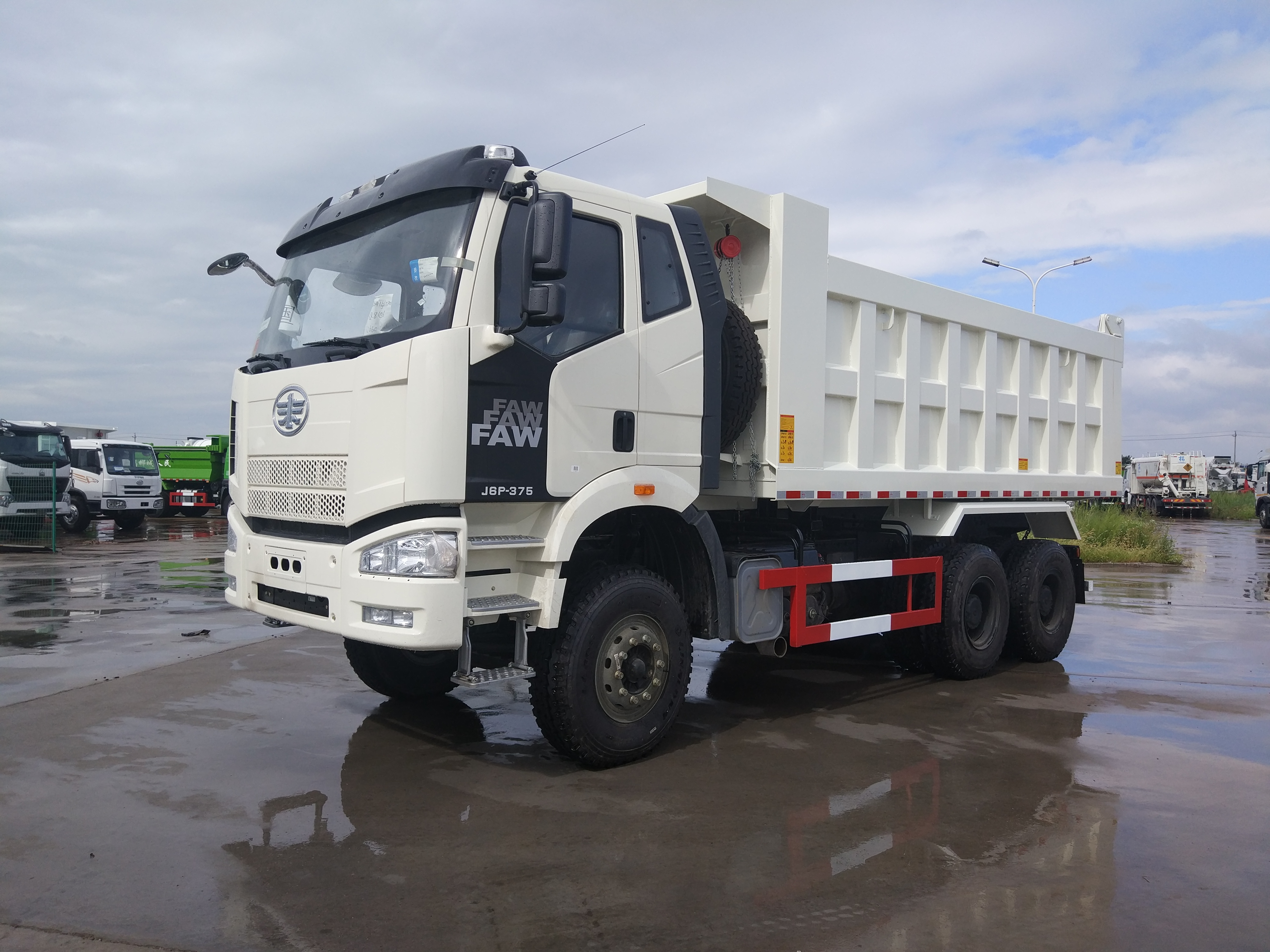
The dump truck configuration: self-contained loading and discharge
A FAW dump truck is a FAW TRUCK built with a dump body. In the published body-type list, dump truck appears alongside tractor truck, cargo truck, concrete mixer truck and a range of special-purpose bodies. Its functional advantage is simple: the vehicle carries the material and discharges it without a separate trailer or a tipping station.
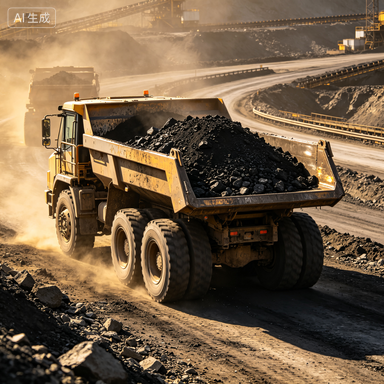
Published application data links this configuration to coal and other mineral transportation and to building materials transportation, and to goods transport in construction site and factory projects. Those are exactly the flows where material has to be dropped at a stockpile, a crusher, a batching plant or a fill face.
The same application data describes operation on muddy terrain and under high temperature conditions, with a stated requirement for stable operation under complex road conditions. For a mining buyer, that translates into two specification conversations: drive configuration and tires.
Rear-wheel drive configurations of 6×4 and 6×2, and all-wheel drive configurations of 6×6 and 8×8, are referenced in the published application data. Tire specifications for FAW trucks are available based on customer needs — meaning the tire package is a buyer decision, not a fixed default, and it should be written into the order rather than discovered at delivery.
A documented FAW J6P 8×4 dump truck configuration (CA5310) is listed with an 11L CA6DM2 engine rated at 390 hp. Buyers should treat this as a configuration reference point and confirm the exact engine rating, gearbox and axle set on their own quotation.
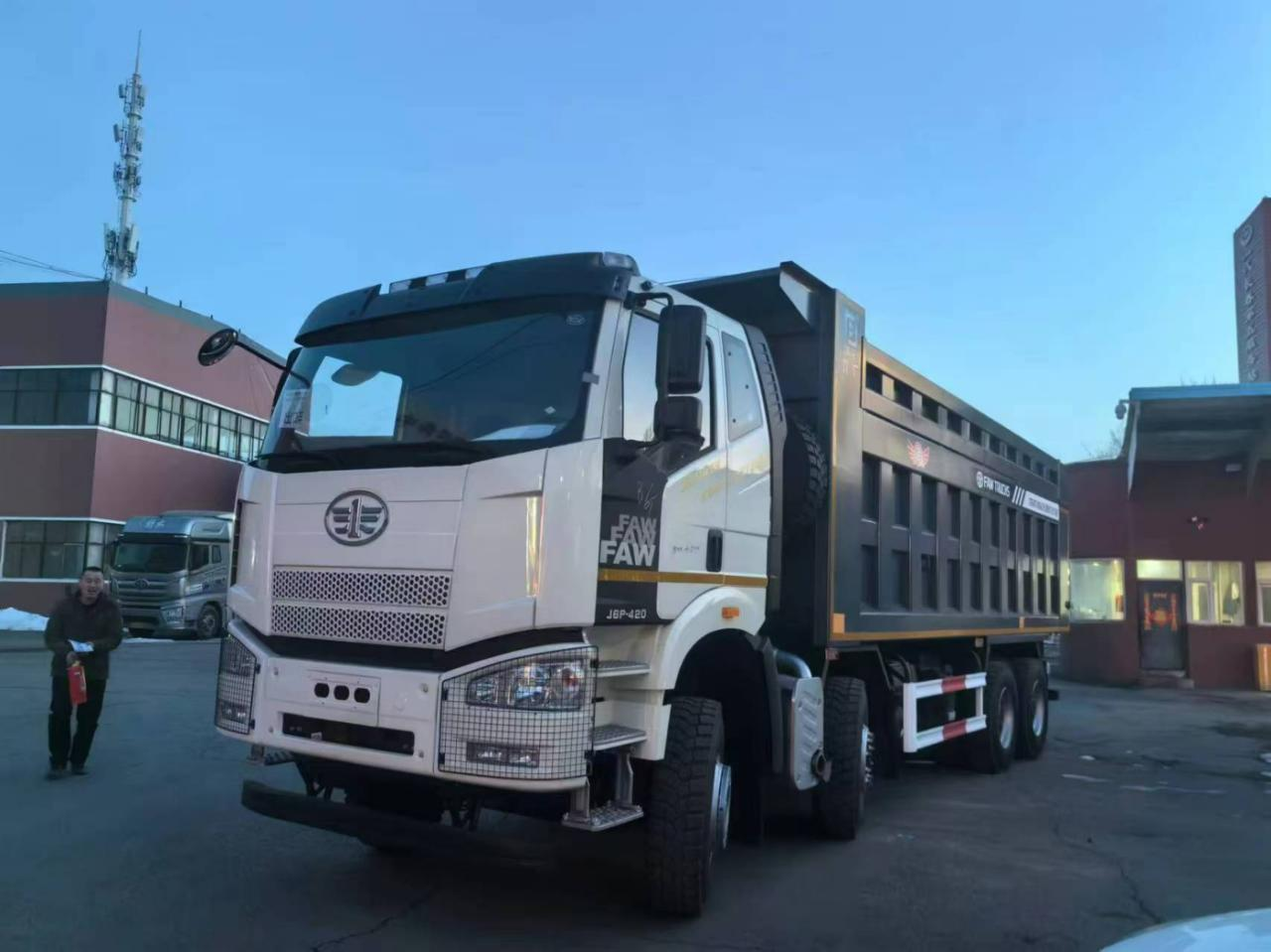
The tractor truck configuration: moving trailers, not material
The FAW tractor truck is classified in published product data as a tractor truck suitable for port transportation, logistics freight distribution and other heavy-duty applications, with overall dimensions from 6000×2300×3000 mm to 12000×2550×3800 mm and a net weight of 3000–15000 kg.
Its value in a port or logistics operation is that it decouples the power unit from the cargo unit. One tractor can work a container skeleton trailer on a port shuttle, then a flatbed on an inland run. In a mining operation, the same principle applies where ore or concentrate moves in tipper semi-trailers rather than being tipped by the truck itself.
Because the trailer is part of the system, the tractor decision is never a truck-only decision. CHARY builds semi-trailers in low bed, tipper, flatbed, skeleton container, drop side and tank configurations, and can select international brand components including BPW/FUWA axles, WABCO relay valve and ABS, JOST/SAF outrigger and JOST king pin according to customer requirements. For a port or freight fleet, that means the tractor and the trailer can be specified together, with coupling, axle and braking compatibility addressed in one quotation.

What both configurations share
Whatever body is specified, the published FAW TRUCK parameters that frame the decision are the same:
- Weight range: 3000–15000 kg.
- Overall dimensions: 6000×2300×3000 mm to 12000×2550×3800 mm.
- Construction materials: steel, iron, aluminum alloy and plastic.
- Safety configuration: ABS, EBS and TCS.
- Tires: specifications available based on customer needs.
- Body-type flexibility: the same product line covers tractor truck, dump truck, cargo truck, concrete mixer truck, garbage truck, sprinkler truck, water tank truck, fuel tank truck, wrecker truck, sweeper truck, concrete pump truck, asphalt distributor truck, high altitude platform truck and fire truck.
Step-by-Step Breakdown: Specifying a J6P for a Mining or Port Duty Cycle
Step 1 — Define what happens at the discharge point
If the material must be raised and tipped by the vehicle, you are specifying a dump truck. If the material leaves the vehicle inside a container, on a flatbed or in a tank, you are specifying a tractor truck plus a matched semi-trailer. Everything downstream depends on this answer.
Step 2 — Map the route and the road surface
Published application environments include muddy terrain, high temperatures, humidity, rainy and snowy weather, highways and urban roads. Mine haul roads and port aprons load tires, brakes and drivelines differently. Write the actual surface and gradient into the specification brief rather than describing the site as “rough.”
Step 3 — Choose the drive configuration
Published application data references 6×4 and 6×2 rear-wheel drive configurations and 6×6 and 8×8 all-wheel drive configurations. Match the drive layout to traction demand, not to habit. An 8×4 dump configuration and a 6×4 tractor configuration answer different questions.
Step 4 — Fix the tire specification on paper
FAW truck tire specifications are available based on customer needs. That flexibility is only useful if it is exercised in writing. Confirm tire size, pattern and quantity per axle on the quotation, and confirm the spare-wheel provision at the same time.
Step 5 — Confirm the safety configuration and market documents
ABS, EBS and TCS are the published safety configuration items. Confirm which of these are fitted to the quoted unit, and obtain the destination-market documentation for that exact build. Do not assume that a configuration sold in one market carries the same approvals in another.
Step 6 — Lock purchasing terms and acceptance criteria
Before the order is placed, agree the delivery terms, the inspection method, the documents that must travel with the truck, the spare-parts list for the first service interval, and the written acceptance criteria. This is the step where most fleet disputes originate — not in the workshop.
Use Cases: Matching Configuration to Cargo Flow
Coal and mineral transportation
Named explicitly in FAW's published application list, this is core dump truck territory: load at the face or stockpile, discharge at the crusher, wash plant or rail siding. Where the mine instead moves ore in tipper semi-trailers over longer distances, the tractor configuration with a tipper trailer becomes the working unit.
Construction and building materials
Aggregates, sand, cementitious materials and site spoil follow the same self-discharge logic. Published application data links FAW trucks to building materials transportation and to goods transport in construction site and factory projects — both flows where a dump body removes a handling step.
Port transportation
Container, bulk and general cargo movement inside and around a port is trailer-based by nature. The tractor configuration is the correct starting point, and the semi-trailer — skeleton container, flatbed or tipper — is specified alongside it.
Logistics freight distribution
Regional distribution, line-haul and depot-to-depot movement all depend on interchangeable trailers. The FAW logistics truck in tractor form allows one power unit to serve several trailer types across a working week.
Mixed fleets
Most mining and port operators run both duties. The efficient answer is usually not one compromise vehicle but two builds from the same model family: dump configurations for the self-discharging flows, tractor configurations for the trailer flows. Shared cab family and shared safety configuration simplify driver familiarity and parts planning.
Comparison Table: FAW J6P Dump Truck vs. FAW J6P Tractor Truck
| Decision factor | FAW J6P — dump truck configuration | FAW J6P — tractor truck configuration |
|---|---|---|
| Body type in the FAW TRUCK list | Dump truck | Tractor truck |
| How the load leaves the vehicle | Self-discharging body | Via a coupled semi-trailer |
| Applications named in published data | Coal and other mineral transportation; building materials transportation; construction site and factory projects | Port transportation; logistics freight distribution; other heavy-duty applications |
| Vehicle weight range (line-wide) | 3000–15000 kg | 3000–15000 kg |
| Overall dimensions (line-wide) | 6000×2300×3000 mm to 12000×2550×3800 mm | 6000×2300×3000 mm to 12000×2550×3800 mm |
| Construction materials | Steel, iron, aluminum alloy, plastic | Steel, iron, aluminum alloy, plastic |
| Safety configuration | ABS, EBS, TCS | ABS, EBS, TCS |
| Tire specification | Available based on customer needs | Available based on customer needs |
| Drive configurations referenced in application data | 6×4, 6×2 rear-wheel drive; 6×6, 8×8 all-wheel drive | Same published reference set |
| Dependency to resolve at order stage | Body volume, axle set, tire package, acceptance criteria | Fifth-wheel and trailer match, axle set, trailer braking compatibility, acceptance criteria |
The table compares configurations, not brands. Neither column is universally superior: a tractor truck cannot self-discharge mineral cargo, and a dump truck cannot haul a container chassis. The correct choice is the one that removes a handling step from your own flow.
FAQ: FAW J6P Dump Truck vs. Tractor Truck for Mining and Port Fleets
1. What safety and compliance details should be confirmed before ordering a J6P dump or tractor truck?
The published safety configuration for FAW trucks is ABS, EBS and TCS. Confirm in writing which of these items are fitted to the exact unit being quoted, and obtain the documentation required by the destination market for that specific build. Attach the agreed safety and documentation list to the purchase order so that it forms part of the acceptance criteria rather than an assumption.
2. Can one FAW J6P configuration cover both mining haulage and port tractor work?
No — the body type decides the duty. The J6P appears in FAW's published line-up as a model designation available across multiple body types, including dump truck and tractor truck. The dump configuration is applied to coal and other mineral transportation and to construction-material flows; the tractor configuration is described as suitable for port transportation and logistics freight distribution and other heavy-duty applications. A fleet needing both duties normally specifies two builds.
3. How should a buyer budget for a J6P dump truck versus a tractor truck?
There is no single published figure that covers both builds, because the price follows the configuration: body or trailer preparation, drive layout, tire package, safety items, destination market, freight and documentation all move the number. Request an itemised quotation that separates chassis, body or coupling preparation, tires, safety options, freight and documents, so the two configurations can be compared on the same commercial basis.
4. How can a fleet validate the configuration before committing to a volume order?
For capital equipment, validation is normally a documented configuration review plus a pre-shipment inspection against agreed acceptance criteria, rather than a physical sample vehicle. Put tire specification, body type, safety items and inspection points in writing, and use the supplier's technical documentation and product brochure to align both sides before the order is released.
5. What should be confirmed about lead time and delivery before ordering?
Lead time depends on the build, the body or trailer specification and the destination, so it should be confirmed in writing for the exact configuration rather than inferred from a general statement. As context on export capability, Qingdao Chary Machinery Co., Ltd. has exported to more than 50 countries and regions, with major markets in Africa, the Middle East, Southeast Asia, Central Asia & Eastern Europe and Latin America; export business accounted for 22.7% of total sales and annual export volume reached USD 40 million in 2025. To move forward, send your duty cycle, required body type and destination port to sales@fawglobal.com or +86 186 6398 2168 and request a written quotation with acceptance criteria.
Conclusion: Choose the Body, Then Choose the Specification
The FAW J6P dump truck and the FAW J6P tractor truck are not competing answers to the same question. They are two configurations of one heavy-duty model family, each built for a different point in the material flow. Mining operations that need material tipped at the face, the stockpile or the plant should be specifying the dump configuration. Port and freight operations that move containers, flatbeds and tanks should be specifying the tractor configuration together with a matched semi-trailer.
Once the body type is fixed, the remaining decisions are specification decisions: drive layout, tire package, safety items, dimensions and weight for the exact build, and — critically — the purchasing terms and acceptance criteria that turn an order into a verifiable delivery. Buyers who treat those last items as paperwork rather than engineering are the ones who discover the gap after the trucks land.
Next step: specify the build, then request the quotation
Qingdao Chary Machinery Co., Ltd. is an authorized vehicle export enterprise by the Ministry of Commerce, established in 2015 and based in Qingdao, China. The company is a first-level distributor of FAW TRUCKS and also an export distributor of SINOTRUK, SHACMAN and BEIBEN, with a 1,500,000 m² facility, an annual production capacity of 248,700 units and a workforce of over 3,000 staff, including a 1,000-employee R&D team.
Send the duty cycle — mine, port, construction or distribution — together with the required body type, drive configuration and destination market, and request a written quotation covering configuration, tire specification, safety items, delivery terms and acceptance criteria.
Email: sales@fawglobal.com | Tel / WhatsApp: +86 186 6398 2168 | Address: No. 266 Jiushui East Road, Qingdao, China | Website:www.charymachinery.com
Download the product brochure:CHARY FAW TRUCKS brochure (PDF)
Have Questions or Need More Details?
Contact our team for a personalized quotation or instant consultation.
Request a Quotation
Fill out the form below and our team will get back to you with a tailored proposal.
WhatsApp Direct Chat
Prefer to chat in real-time? Message us on WhatsApp for instant assistance & quick answers.
- Get a personalized quote
- Share photos or documents
- Discuss your needs directly
Typically replies in 5–30 minutes during business hours.