Configuring FAW Trucks for Port and Coal Transport: A Sourcing Blueprint
In short: port work and coal hauling are configured differently. Container and terminal operations are served by FAW tractor units — most often the JH6 and J6P series — matched to skeleton or flatbed container semi-trailers, while coal and mineral hauling is served by 8x4 dump trucks or by 6x4 tractors pulling tipper semi-trailers. This sourcing blueprint covers seven steps: define the duty cycle, choose the truck family and axle configuration, match the body or semi-trailer, verify overall dimensions and weight against the site, lock the emission and compliance envelope, specify components and a wear-part inspection routine, and confirm the export channel and after-sales plan.
Problem Definition: Why One “Heavy-Duty” Specification Does Not Cover Both Sectors
Port and coal operations look alike on a route sheet: short, repeated, heavy cycles with very little time on open highway. Mechanically, they stress a truck in different places, and that is where most sourcing mistakes begin.
In a container yard, a tractor unit works almost entirely at low speed. It creeps under a spreader, reverses into a slot, waits in a queue, then makes a short loaded run to a railhead or warehouse. Stress concentrates in the clutch and transmission, the brakes and cooling system, the fifth wheel and king pin — and, in practice, in the driver, who may spend an entire shift in the cab.
In a coal or mineral pit, the same truck meets a different set of conditions: unpaved haul roads, dust, standing water in the wet season, repeated shock loading when the body is charged, and a genuinely abrasive load environment. Total cost of ownership there is dominated by consumable parts — tyres, brake linings, bushes, filters, hydraulic components and body liners.
That difference explains why a single generic “heavy-duty” specification tends to disappoint. The documented risk profile for these fleets identifies damage to consumable parts as the primary exposure, and the control method is not a larger engine: it is the regular inspection of wear parts, supported in practice by engineers who visit the site to assist with repairs. Buyers who plan for that routine at the procurement stage — choosing a configuration whose consumables are accessible and whose spare parts are available globally — generally run a lower operating cost than buyers who simply order the largest unit in the catalogue.
A second, less visible failure mode is compliance. Heavy-duty truck import rules are not uniform across export markets. Kenya, for example, applies the KS 1515:2019 standard to heavy-duty trucks in its market, requiring vehicles to be no more than 8 years old and right-hand drive. Emission expectations differ as well: FAW provides Euro II, Euro III and Euro V standard vehicles for the African and Southeast Asian markets to comply with local fuel quality and environmental regulations. A configuration that is accepted in one market can be refused entry in another.
The practical conclusion is that port and coal sourcing is a configuration problem, not a strength problem. The real question is which axle layout, body type, dimension envelope and emission level fits this specific operation and this specific import market.
Industry Background: Where FAW Trucks Sit in the Export Heavy-Duty Segment
FAW Jiefang maintained its position as China’s leading heavy-duty truck manufacturer in 2024, with total sales reaching approximately 241,700 units (CVWorld / China Automotive News). Overseas exports reached a record high of 64,000 units in 2024, a year-on-year increase of 42% (FAW Group Official). For fleet buyers the value of that scale is practical rather than symbolic: production volume large enough to keep parts flowing, and an export channel mature enough to support trucks operating far from the factory.
Model concentration inside that channel is easy to trace. The JH6 and J6P series are the primary models exported to Southeast Asia and the Middle East for long-haul logistics and mining operations (Mordor Intelligence). In Nigeria, FAW Trucks operates through local assembly partnerships such as Transit Support Services (TSS), focusing on 6x4 tractor units and 8x4 dump trucks for the construction sector (Vanguard News Nigeria). Together, those two data points define the starting point for both sectors covered here: a 6x4 tractor family for port and road logistics, and an 8x4 dump family for mineral and construction hauling.
On the supply side, Qingdao Chary Machinery Co., Ltd (CHARY) is an enterprise for vehicle export authorized and approved by the Ministry of Commerce of China. Founded in 2015 and based in Qingdao, CHARY is a first-level distributor of FAW TRUCKS and also an export distributor of SINOTRUK, SHACMAN and BEIBEN. Its product scope covers dump trucks, tractor trucks, rigid trucks, special purpose trucks and semi-trailers, together with engineering machinery such as wheel loaders, motor graders, bulldozers, forklifts and road rollers, plus spare parts.
CHARY’s own semi-trailer range is directly relevant to port and coal projects, because the tractor or chassis and the trailer or body can be specified as one package rather than sourced separately: low bed semi-trailers, tipper semi-trailers, flatbed and skeleton container semi-trailers, drop side semi-trailers and tank semi-trailers. International brand components can be selected according to customer requirements, including BPW or FUWA axle, WABCO relay valve and ABS, JOST or SAF outrigger, and JOST king pin.
The company reports an annual export volume of USD 40 million in 2025 and an export ratio of 22.7%, with sales into more than 50 countries and regions — among them Algeria, Ethiopia, Somalia, Tanzania, Nigeria, Mozambique, Zambia, Malawi, Ghana, Mali, Congo, Senegal, Peru, Chile, Guyana, Indonesia, Singapore and the Philippines. Supporting capacity is reported at a 1,500,000 m² facility with more than 3,000 employees, a 1,000-person R&D team and an annual output of 248,700 units.
Detailed Solution: Configuring the Truck to the Duty Cycle
Port and terminal transport: a tractor-first configuration
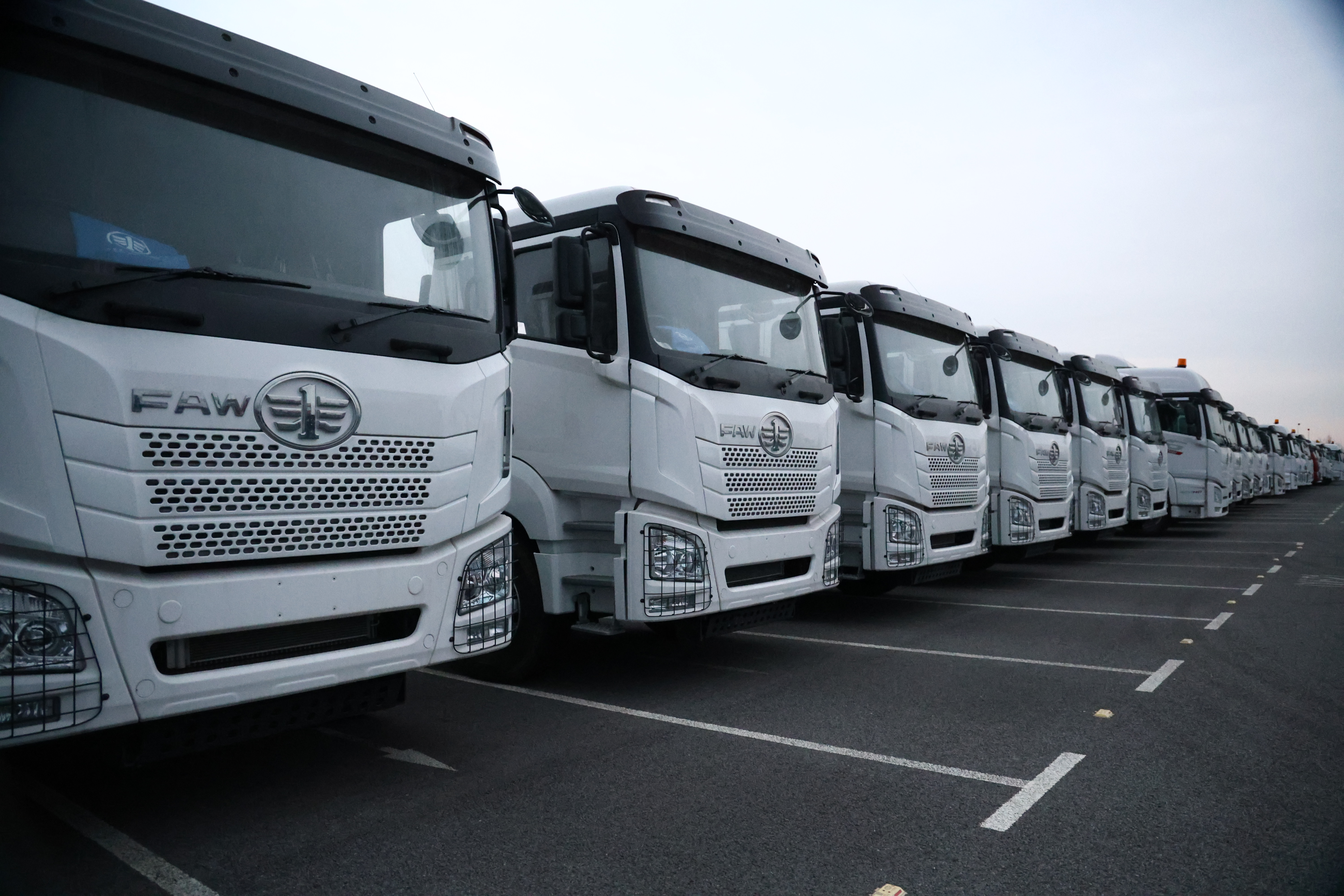
Port operations need tractor units, and the decision set is narrow: axle configuration, cab type, engine and emission level, and the semi-trailer behind the tractor.
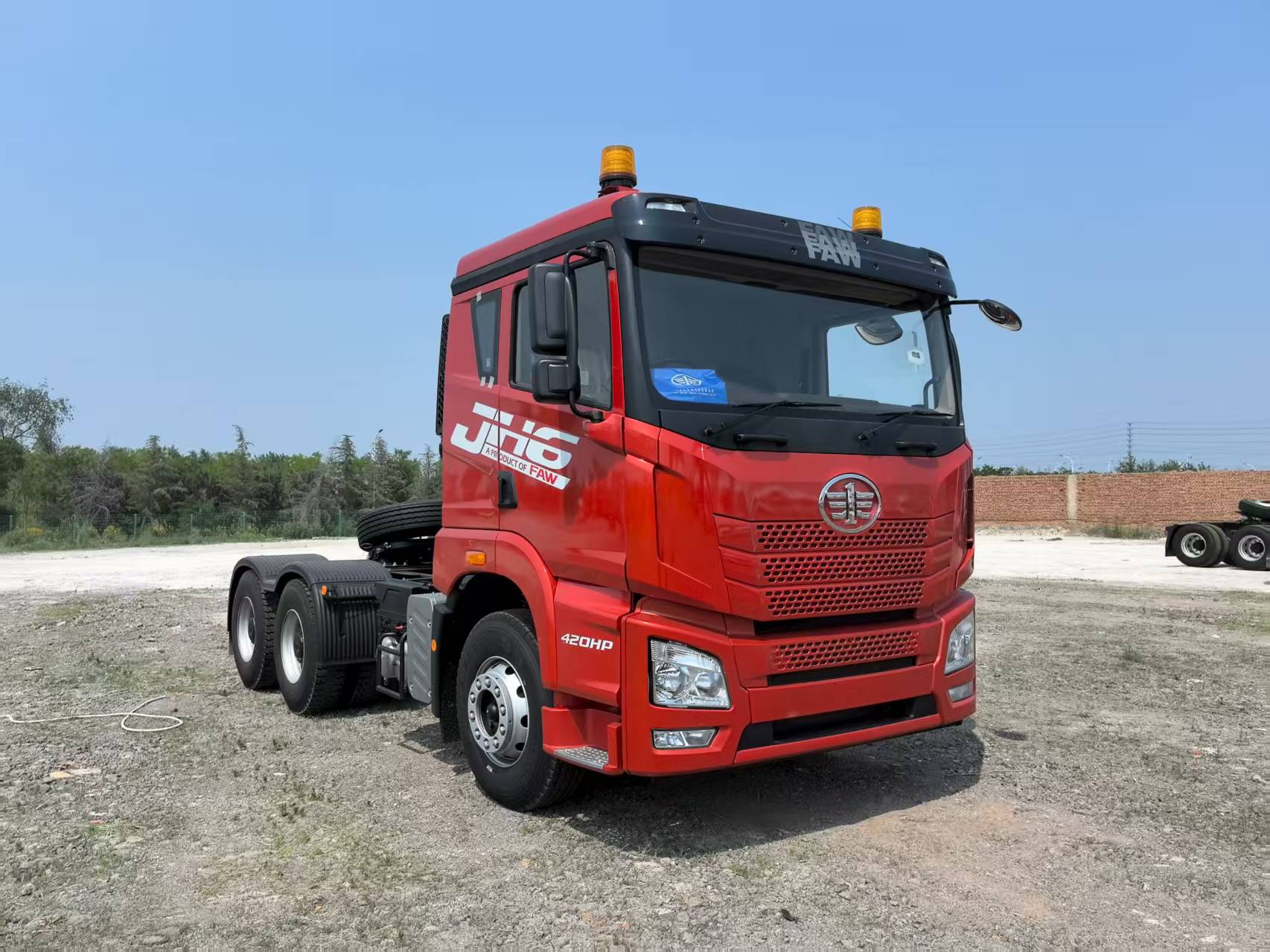
- 6x4 tractor units — the default for loaded container moves between quay, yard, railhead and inland warehouse. The JH6 and J6P series are the primary FAW tractor families in export markets.
- 4x2 tractor units — shorter and more maneuverable, typically used for internal yard shunting and short transfers where axle load is not the binding constraint.
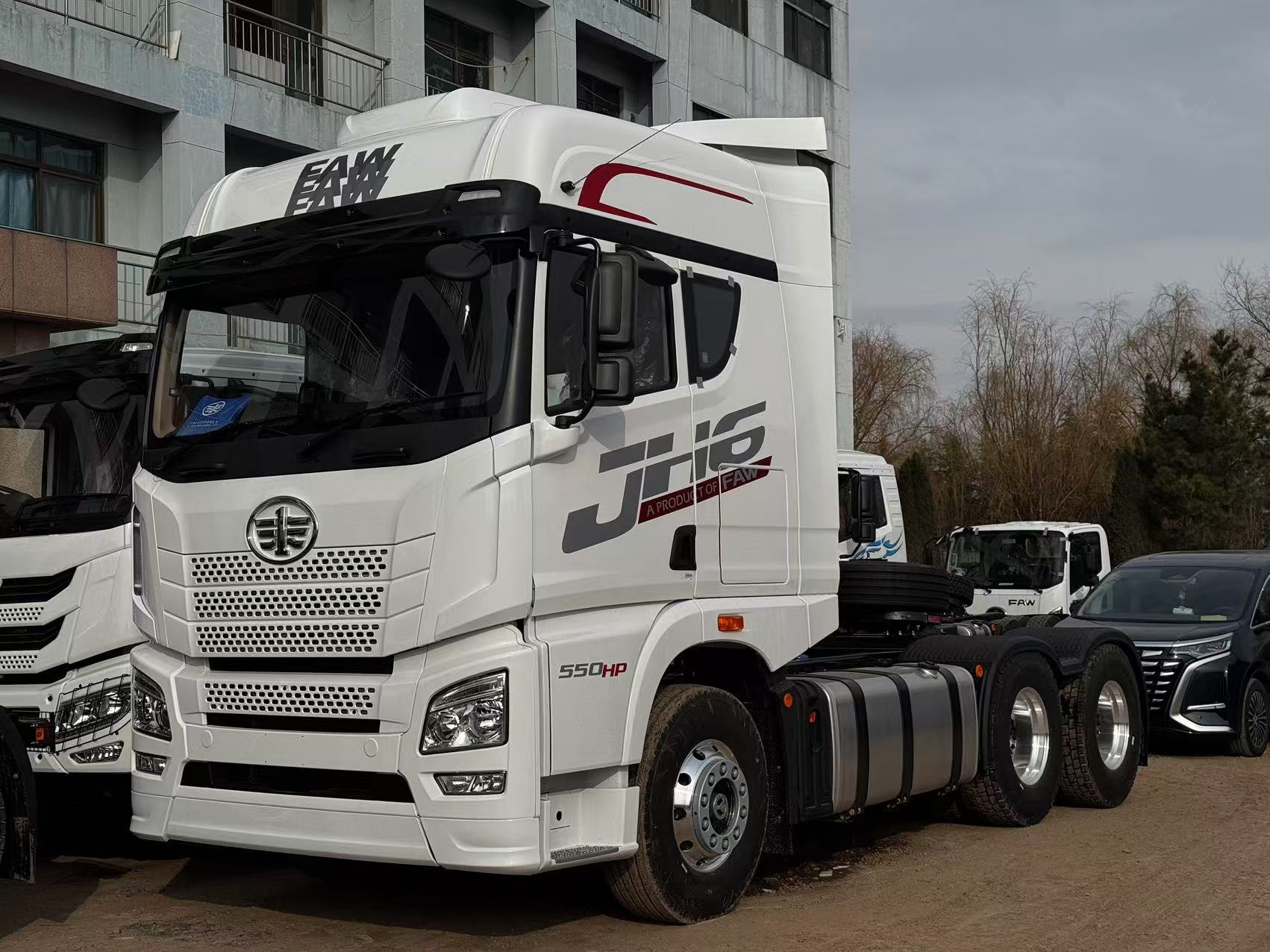
- Cab choice — a flat roof cab suits yard and short-haul work where overall height and cost matter more than living space; a high roof cab (for example the documented JH6 high roof 6x4 550HP configuration) suits drivers who spend the full shift in the truck and need rest space.
Trailer matching is where a port configuration is won or lost. A skeleton container semi-trailer minimises tare weight for 20 ft and 40 ft container moves; a flatbed semi-trailer is more flexible if the operation also carries non-containerised cargo. Axles (BPW or FUWA), braking components (WABCO relay valve and ABS), landing gear (JOST or SAF outrigger) and king pin (JOST) can be specified to match the workshop’s existing parts inventory — an advantage that only becomes visible later, when consumables are replaced.
Coal and mineral hauling: a body and consumable-first configuration
Coal and mineral work is dump-first. The documented FAW configuration for heavy construction and mineral hauling in Africa is the 8x4 dump truck, used alongside 6x4 tractor units in markets such as Nigeria. Two starting points are therefore available:
- 8x4 dump truck — high payload on a rigid chassis, best where haul roads are short, gradients are known and the site can support rigid-body maintenance.
- 6x4 tractor with tipper semi-trailer — an articulated alternative that distributes load differently, allows the tractor to be redeployed while the body is offline, and suits operations that combine pit haulage with public-road movement.
For both options, operating cost is decided by consumables. Tyres, linings, bushes, filters and hydraulic components wear faster in a pit than in any other duty cycle, and shock loading while charging the body accelerates structural fatigue. The documented control method is a scheduled inspection routine for wear parts, backed by the enterprise measure that engineers visit the site to assist with repairs. In procurement terms that becomes two checklist items: confirm the wear parts are accessible with the tools available on site, and confirm that spare parts for the selected configuration are available globally.
Cab, powertrain and configuration range
Documented comparison data places FAW trucks ahead of Beiben, Sinotruk and Shacman on several points that matter in both sectors: more available truck configurations and a more spacious, comfortable driver’s cab. Performance advantages include higher engine power and better fuel efficiency. Repair is described as more convenient and simple, maintenance efficiency is higher, and spare parts are available globally. The cited core differences are higher output and superior after-sales support, with a cost position around 10% lower than the alternatives.
For port work, a wider configuration range means the tractor can be specified to the terminal instead of the terminal being adapted to the tractor. For coal work, easier repair and higher maintenance efficiency directly reduce the downtime a pit cannot absorb — a stopped haul truck stops the cycle behind it.
Overall dimensions and weight: verify, do not assume
Exact dimension and weight figures vary by model, cab, wheelbase, body and trailer, so they should be confirmed against the specific build sheet rather than assumed from a brochure. The items to fix before ordering are consistent across both sectors:
- Overall length, overall width, and overall height — for dump units both body lowered and body raised
- Wheelbase, plus front and rear overhang
- Gross vehicle weight, and for tractor units the gross combination weight
- Axle load distribution, front and rear
- Body volume, or container position for the semi-trailer
Those values are then checked against the operating environment: terminal gates, yard turning circles and stacking aisles for port units; ramp width, gradient, haul-road condition and tipping clearance for coal units; and, in both cases, the axle-load and dimension limits of the public roads the truck will use. This is the step where most cross-border surprises are avoided, because a truck that fits the site but not the road regulation is not a usable asset.
Step-by-Step Breakdown: A Seven-Step Sourcing Blueprint
Step 1 — Define the duty cycle in operational terms. Write down trips per shift, tonnes or TEU per trip, one-way distance, road surface, maximum gradient, operating hours and whether the truck leaves the site. Port shuttle work and pit haulage will produce two different answers, and the answer drives everything that follows.
Step 2 — Choose the truck family and axle configuration. Tractor-first for container and terminal work, most often 6x4 with 4x2 as a shunting option. Dump-first for coal and mineral work, most often 8x4 rigid or 6x4 articulated. The JH6 and J6P series are the primary FAW models in export logistics and mining duty.
Step 3 — Match the body or semi-trailer to the load. Skeleton or flatbed container semi-trailers for port work; tipper semi-trailers or a rigid dump body for coal. Confirm that the trailer or body, the tractor and the components are specified as one package, including axle, braking and coupling components.
Step 4 — Verify overall dimensions and weight against the site and the road. Confirm length, width, height, wheelbase, gross vehicle weight, gross combination weight and axle load distribution on the build sheet, then check them against terminal geometry, mine haul roads and local road regulation.
Step 5 — Lock the emission and compliance envelope. Select the emission level that matches local fuel quality and regulation — FAW supplies Euro II, Euro III and Euro V vehicles for African and Southeast Asian markets — and check market-specific import rules such as the age and right-hand-drive requirements of KS 1515:2019 in Kenya.
Step 6 — Specify components and the wear-part routine. Decide the axle, braking, landing gear and king pin brands at the order stage so they match your workshop inventory, then build the scheduled inspection of wear parts into the operating plan, with access to on-site engineer support for repairs.
Step 7 — Confirm the export channel and the after-sales plan. Work through a channel with documented export authorisation, distributor status and a spare-parts pathway, and confirm how parts will reach your site before the first truck arrives.
Use Cases: How the Blueprint Applies in Practice
1. Container terminal and yard shuttle, West Africa
A terminal moving containers between quay, stack and railhead is a short-cycle operation. A 6x4 tractor unit with a skeleton container semi-trailer covers loaded moves, while a lighter 4x2 unit handles internal transfers. The configuration priorities are turning ability, fifth wheel and king pin durability, and brake cooling; overall height and axle load must be checked against the terminal gates and any public-road transfer. Nigeria is a reference market, where FAW operates through local assembly partnerships such as Transit Support Services (TSS) with a focus on 6x4 tractor units.
2. Coal mine to railhead, Southern Africa
Pit-to-rail haulage is a consumable-driven operation. An 8x4 dump truck is the documented FAW configuration for heavy construction and mineral hauling in African markets. Priorities shift to body strength, dust protection, tyre and lining life, and a scheduled inspection routine for wear parts. Engine support for repairs on site shortens unplanned downtime, which is the single largest cost driver in a haul cycle where every truck feeds a fixed loading rate.
3. Mineral road haulage with a tipper semi-trailer, Southeast Asia
Where minerals travel part of the route on public roads, an articulated 6x4 tractor with a tipper semi-trailer distributes load more flexibly and keeps a spare tractor productive if the body is under repair. Emission level and legal axle load become the limiting factors, and the emission selection has to match local fuel quality — one reason FAW supplies Euro II, Euro III and Euro V vehicles for African and Southeast Asian markets.
4. Mixed construction and logistics fleet
Many buyers operate both duty cycles with one fleet. Documented application coverage for FAW trucks includes urban construction, logistics and transport, livestock transport and fresh goods transport, with more truck configurations available than the comparison set. A mixed fleet should therefore be planned as a configuration matrix rather than a single model purchase, so that tractors, dump units and trailers share components wherever possible.
Comparison Table: Documented FAW Position and Configuration Decisions
The table below uses the documented comparison data for FAW trucks against Beiben, Sinotruk and Shacman, together with the application decisions described above. Competitor specifications are not stated here and should be verified directly with each supplier for a live project.
| Comparison Dimension | Documented FAW Position (vs Beiben, Sinotruk, Shacman) | Why It Matters in Port and Coal Work |
|---|---|---|
| Output | Higher output is cited as a core difference | Higher throughput per truck in fixed loading cycles |
| After-sales support | Superior after-sales support; spare parts available globally | Shorter downtime in remote port and mine locations |
| Engine power | Higher engine power | Better performance under load on gradients and in yard start-stop work |
| Fuel efficiency | Better fuel efficiency | Fuel is a major share of cost per tonne moved |
| Repair and maintenance | Repair is more convenient and simple; higher maintenance efficiency | Faster turnaround between shifts; less dependence on specialist tooling |
| Cab | More spacious and comfortable driver’s cab | Long shifts in port queues and mine hauling; driver retention and safety |
| Configuration range | More truck configurations available | The truck can be specified to the site rather than the reverse |
| Cost position | 10% lower cost over alternatives | Lower capital exposure when scaling a fleet |
| Documented applications | Urban construction, logistics and transport, livestock transport, fresh goods transport | Useful boundary check when the fleet also serves non-port or non-mine routes |
| Configuration Decision | Port / Terminal Operation | Coal / Mineral Operation |
|---|---|---|
| Primary truck type | Tractor truck (JH6, J6P series) | 8x4 dump truck, or 6x4 tractor with tipper semi-trailer |
| Axle configuration | 6x4 for loaded moves; 4x2 for shunting | 8x4 rigid or 6x4 articulated |
| Body / trailer | Skeleton or flatbed container semi-trailer | Dump body or tipper semi-trailer |
| Cab choice | Flat roof for yard work; high roof for shift-long driving | Durable cab with dust protection; comfort matters on long shifts |
| Dominant wear | Clutch, brakes, fifth wheel and king pin | Tyres, linings, bushes, filters, body liners |
| Key maintenance routine | Fifth wheel, king pin and brake thermal checks | Scheduled inspection of wear parts, with engineer support for repairs |
| Compliance focus | Overall dimensions and axle load for road transfer | Emission level and import age / steering rules (for example KS 1515:2019 in Kenya) |
| Components to specify | BPW or FUWA axle, WABCO relay valve and ABS, JOST or SAF outrigger, JOST king pin | Same component options, plus body and tipping system specification |
FAQ: Configuring and Sourcing FAW Trucks for Port and Coal Transport
1. Which emission standards and import rules apply to FAW trucks used in port and coal transport?
FAW provides Euro II, Euro III and Euro V standard vehicles for the African and Southeast Asian markets, matched to local fuel quality and environmental regulations. Import rules sit on top of the emission question: heavy-duty trucks entering the Kenyan market, for example, must satisfy KS 1515:2019, which requires a vehicle age of no more than 8 years and right-hand drive. Because these requirements differ by country, the emission level and the steering configuration should be fixed at the quoting stage rather than after the order is placed.
2. Which FAW truck models are used for port container handling and coal hauling?
Port container and terminal work is tractor work, and the JH6 and J6P series are the primary FAW models exported to Southeast Asia and the Middle East for long-haul logistics and mining operations. Coal and mineral hauling is dump work: in Nigeria, FAW Trucks operates through local assembly partnerships such as Transit Support Services (TSS), focusing on 6x4 tractor units and 8x4 dump trucks for the construction sector. In practice the choice is between an 8x4 dump truck on a rigid chassis and a 6x4 tractor pulling a tipper semi-trailer.
3. What should a buyer budget for a new FAW truck in these applications?
Published third-party market data provides an anchor for the Philippines, where a new FAW 6x4 tractor truck typically ranges from PHP 3,200,000 to PHP 4,500,000 depending on engine configuration (WP10 / WP12) and emission level. That range is market-specific and should be verified locally. On a comparative basis, FAW trucks are documented as providing 10% lower cost over alternatives such as Beiben, Sinotruk and Shacman, with the core differences cited as higher output and superior after-sales support. For a fleet, the more useful budgeting unit is cost per tonne moved, which combines purchase price with fuel efficiency, maintenance efficiency and the availability of spare parts.
4. Can the configuration and component list be confirmed before an order is placed?
Yes — configuration is the main variable in this type of procurement. FAW trucks are documented as offering more available truck configurations than Beiben, Sinotruk and Shacman, and CHARY’s semi-trailer range (low bed, tipper, flatbed / skeleton container, drop side and tank) allows the trailer or body to be matched to the tractor. International brand components can be selected according to customer requirements, including BPW or FUWA axle, WABCO relay valve and ABS, JOST or SAF outrigger, and JOST king pin. Buyers should confirm final dimension and weight figures — overall length, width and height, wheelbase, gross vehicle weight and axle load distribution — against the build sheet before releasing the order. The CHARY product brochure can be downloaded for review.
5. What affects delivery lead time and long-term support for a port or coal fleet?
Two factors dominate. The first is the production capacity behind the order: reported capacity includes an annual output of 248,700 units supported by more than 3,000 employees and a 1,000-person R&D team, and CHARY reports an annual export volume of USD 40 million in 2025 across more than 50 countries and regions, with an export ratio of 22.7%. The second is after-sales readiness — spare parts available globally, and engineers who visit the site to assist with repairs. Buyers planning a port or coal fleet can share their duty cycle and target market with the CHARY team to receive a configuration review and quotation before committing to an order.
Conclusion: Configuration First, Then Sourcing
Port and coal transport reward different configurations, and the sourcing blueprint is the same in both cases. Define the duty cycle, select the truck family and axle layout (6x4 and 4x2 tractors for the terminal; 8x4 dump trucks or 6x4 tractors with tipper semi-trailers for the pit), match the body or semi-trailer, and verify overall dimensions and weight against the site and the road rather than the brochure. Then lock the emission and compliance envelope for the destination market, specify components and a wear-part inspection routine, and confirm that the export channel can support the fleet after delivery.
The model logic is already established in the export market: the JH6 and J6P series are the primary FAW models for long-haul logistics and mining duty, and the 8x4 dump truck is the documented heavy-haul configuration in African construction and mineral work. Around that logic, the documented FAW advantages — higher output, superior after-sales support, more available configurations, a more spacious and comfortable cab, higher engine power and better fuel efficiency, with a cost position around 10% lower than comparable alternatives — are the levers that decide total cost per tonne moved, not the headline spec sheet.
Next Step: Configure Your Port or Coal Fleet with CHARY
Qingdao Chary Machinery Co., Ltd (CHARY) is a first-level distributor of FAW TRUCKS and an enterprise for vehicle export authorized and approved by the Ministry of Commerce of China, serving buyers in more than 50 countries and regions across Africa, the Middle East, Southeast Asia, Central Asia, Eastern Europe and Latin America.
- Product brochure (PDF): Download the CHARY catalog
- Website: www.charymachinery.com
- Email: sales@fawglobal.com
- Tel / WhatsApp: +86 186 6398 2168
- Contact: Jason
- Address: No. 266 Jiushui East Road, Qingdao, China
Send your duty cycle — port shuttle, coal haul, or a mixed fleet — together with your target market, and the CHARY team will return a configuration recommendation, sample and quotation package for review.
Have Questions or Need More Details?
Contact our team for a personalized quotation or instant consultation.
Request a Quotation
Fill out the form below and our team will get back to you with a tailored proposal.
WhatsApp Direct Chat
Prefer to chat in real-time? Message us on WhatsApp for instant assistance & quick answers.
- Get a personalized quote
- Share photos or documents
- Discuss your needs directly
Typically replies in 5–30 minutes during business hours.