
FAW Truck and Minidozer Safety Standards & Compliance Basics
FAW Truck and Minidozer Safety Standards & Compliance Basics
Safety standards on a compact equipment lineup come down to three documentable items: the braking and control systems fitted to the machine, the materials it is built from, and the approvals that let it work in a specific market. On the CHARY lineup, FAW truck models list ABS, EBS and TCS as their security configuration. The CR468C minidozer is a lithium battery machine operated by remote control, which keeps the operator outside the work zone instead of inside it. Both product families are documented with the same material composition: steel, iron, aluminum alloy and plastic. This page explains what each of those facts means for buyers who are evaluating equipment and preparing to execute an order - and, just as importantly, which approvals are documented and which still have to be confirmed locally before a purchase decision is final.
Quick answer: FAW truck models document ABS, EBS and TCS as the braking and traction configuration. The CR468C minidozer documents remote control with a control distance of up to 200 m, lithium battery power and a -10 °C to 60 °C working range. Both families use steel, iron, aluminum alloy and plastic. Two approval documents are held in the current evidence set - ECER105 and a GSO GCC certificate - while no approval document is held for the CR468C minidozer, and no other certification should be assumed.
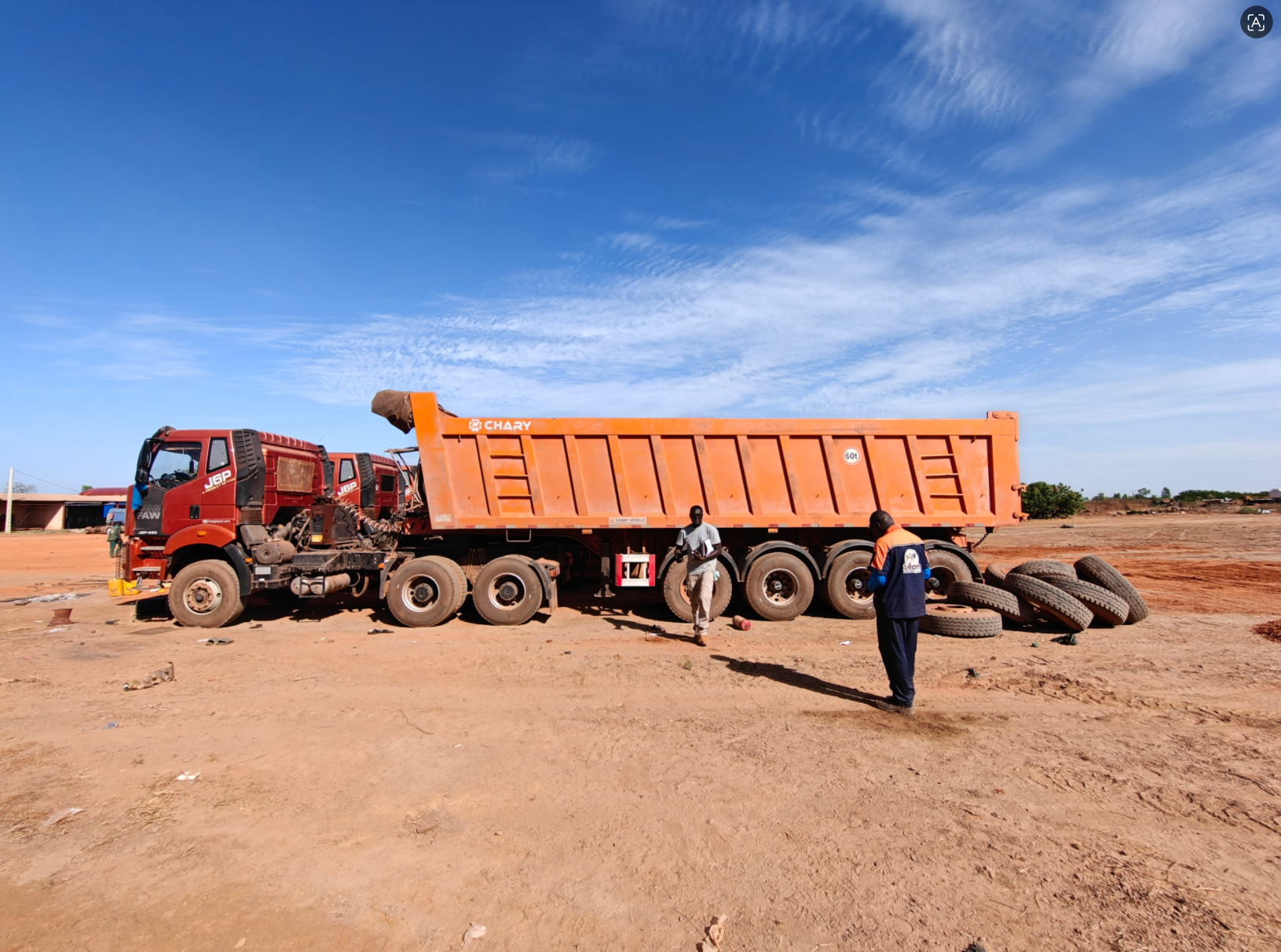
The compliance problem: machines that work but cannot be registered
Technical performance and legal usability are two separate tests for imported equipment, and they fail for different reasons. A truck can pull a full load every day and still stall at registration, because the braking configuration evidence, the emission class or the inspection paperwork does not match what the destination authority asks for. A compact loader can work flawlessly on site and still create problems when it crosses a border, because documentation travels with the machine, not with the job.
For compact machinery, the mismatch usually appears in four places:
- Braking and control evidence. Road-going trucks are assessed on the systems they carry. FAW truck models document ABS, EBS and TCS, which is the configuration buyers are asked to name when they complete a registration file.
- Approval coverage. A certificate normally names a specific model, a specific category and a specific market. A document covering one truck model is not evidence for another model, and it is not evidence for a minidozer.
- Operating environment. A minidozer working in a high-temperature, confined plant space has different requirements from a truck on an open highway. The CR468C documents a -10 °C to 60 °C working range, which is the kind of figure an operator needs when the site is hot and enclosed.
- Commercial terms and inspection. Acceptance criteria, delivery terms and pre-shipment inspection sit at the end of the process, and they decide whether the equipment that arrives is the equipment that was approved.
This page handles both halves of that problem: the documented safety hardware, and the documented paperwork that has to travel with it. The working rule throughout is to state only what is documented, and to verify everything else with the market authority before the order is placed.
Industry background: more compact machinery crossing borders means more documentation checks
Compliance carries more weight today than it did a decade ago, because the volume of cross-border compact equipment has grown steadily. Global Market Insights estimates the global compact construction equipment market at USD 43.5 billion in 2024, with a projected value of USD 69.1 billion by 2034. OEC data records that China concentrated 27.3% of total global exports of machines in 2024, keeping its position as the world's largest exporter in the sector. Grand View Research valued the global skid steer loader market at approximately USD 9.4 billion in 2023, with North America accounting for 84.7% of that revenue. Future Market Insights projects the mini track machinery market growing at a 4.5% CAGR to USD 11.31 billion by 2035, with mini track loaders holding a 54% share.
That growth is exactly why buyers now ask for certificate numbers before they ask for prices. Every unit that leaves a factory and enters a different regulatory system creates a paperwork trail, and every gap in that trail becomes a delay at the port, at registration or at the insurance stage.
Qingdao Chary Machinery Co., Ltd is a Qingdao-based supplier of mini machinery and trucks, founded in 2015 and authorized for vehicle export by China's Ministry of Commerce. The company operates a 2,000 m² facility with more than 100 employees and 15 engineers, runs a documented 80% export ratio, and reported an annual export volume of USD 40 million in 2025. Its stated main markets are Africa and South America, with shipments recorded across more than 50 countries and regions, including Algeria, Ethiopia, Tanzania, Nigeria, Mozambique, Zambia, Ghana, Mali, Peru, Chile, Indonesia and the Philippines. The mini machinery side of the portfolio covers the minidozer, mini loader, mini electric loader and skid steer loader.
Safety systems across the CHARY lineup
FAW truck chassis: ABS, EBS and TCS
These three systems do different jobs, and buyers are usually asked to name all of them in a registration or inspection file:
- ABS - anti-lock braking system. Prevents the wheels from locking during hard braking, so the driver keeps steering control instead of sliding.
- EBS - electronic braking system. Manages brake application electronically, giving faster and more consistent response and supporting the anti-lock function.
- TCS - traction control system. Reduces wheel spin when the drive wheels lose grip, which matters on wet, loose or gravel surfaces and during loaded starts.
On the FAW truck models documented here, ABS/EBS/TCS is the listed security configuration. The truck weight range covers 3,000-15,000 kg, overall dimensions run from 6,000 × 2,300 × 3,000 mm to 12,000 × 2,550 × 3,800 mm, and tire specifications are available based on customer needs. Body configurations include tractor, dump, cargo and light truck, concrete mixer, garbage, sprinkler and water tank, fuel tank, wrecker, sweeper, concrete pump, asphalt distributor, high altitude platform and fire truck types.
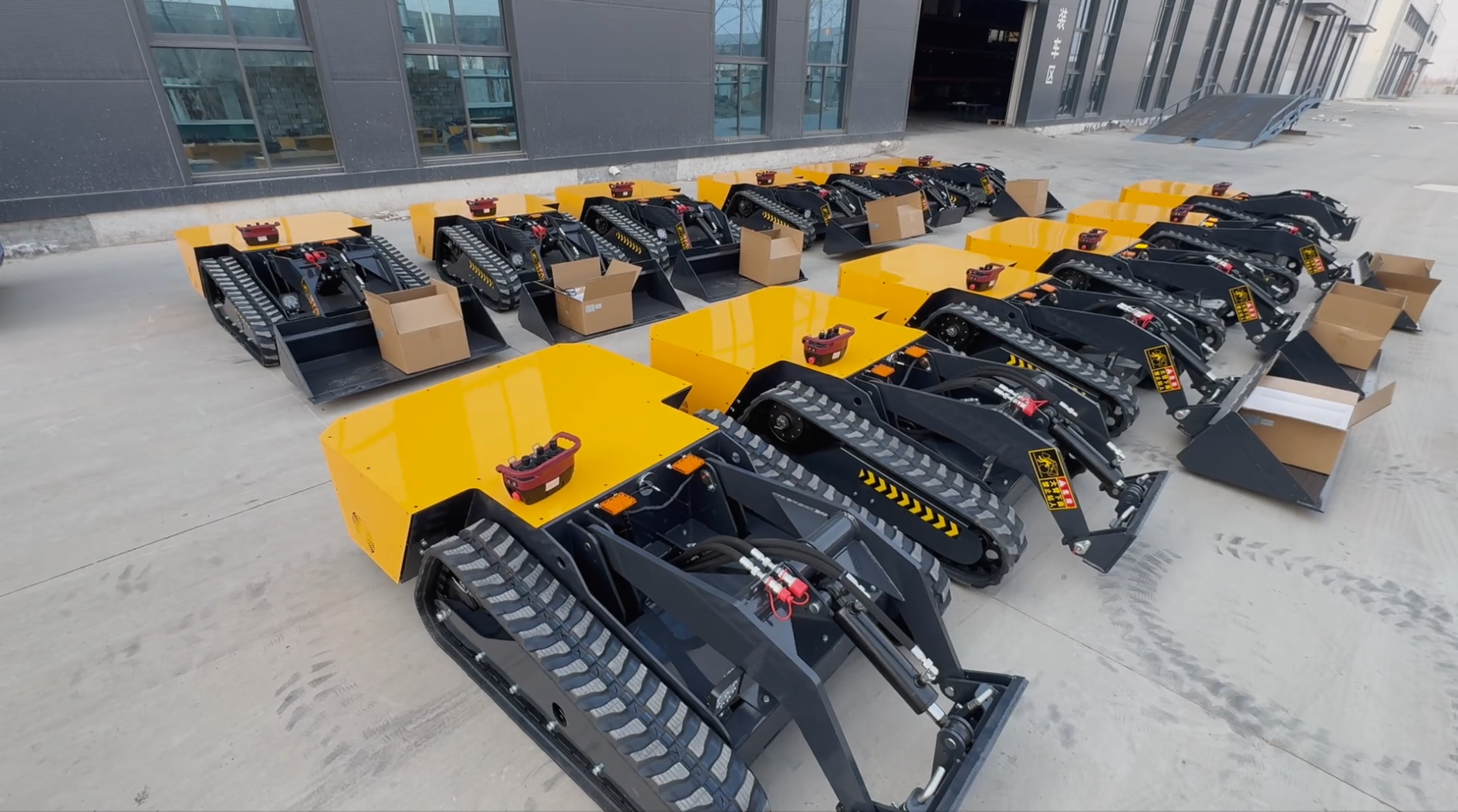
CR468C minidozer: remote control, lithium power and operator separation
The CR468C approaches the same safety problem from a different angle. Instead of protecting an operator inside a cab, it removes the operator from the machine entirely. It is a remote-controlled, lithium battery, rubber track minidozer, and the documented figures describe a machine built for tight, hot or awkward spaces:
- Control distance: up to 200 m
- Self weight: 1,100 kg; rated load capacity: 450 kg
- Overall dimensions: 2,850 × 1,200 × 600 mm; bucket width: 1,200 mm; bucket capacity: 0.15 m³
- Minimum ground clearance: 150 mm; unloading height: 530 mm; bucket unloading time: 1.1 s
- Maximum driving speed: 4 km/h; climbing ability: 40°; steering: 360° spin in place
- Battery: lithium, 300 Ah at 73.6 V (22 Kw/h); motor: 7.5 kW at 3,000 rpm; charging time about 2 h; working time about 8 h; charging voltage 380/220 V
- Hydraulic flow: 58 L/min; hydraulic tank: 20 L; walking style: rubber tracks
- Working temperature: -10 °C to 60 °C
Read as a safety package, those numbers say three things. The operator stands away from the bucket and the track line, at a control distance of up to 200 m. The machine is narrow enough to work inside doorways and corridors where a full-size loader cannot turn. And it is rated for a heat range that covers both cold-weather construction and high-temperature plant environments, which is where this class of equipment is often deployed.
Material composition and the durability baseline
Both the truck family and the CR468C minidozer are documented with the same material composition: steel, iron, aluminum alloy and plastic. That is the baseline a buyer should use when discussing durability, and it is also the point where a supplier conversation should get specific.
- Steel carries structural load - frames, booms, buckets and load-bearing members.
- Iron appears in cast, high-wear components where hardness matters more than weight.
- Aluminum alloy reduces weight in components where mass directly affects handling, fuel use or battery use.
- Plastic covers panels, housings and non-structural parts, where the priority is protection and serviceability rather than strength.
A material list on its own does not prove durability. What it does is give buyers a checklist: ask the supplier to map each material group to the components that carry load or wear, and ask which of those components are available as service parts. On a minidozer working in a confined, high-temperature environment, track life and battery life matter as much as the frame - and both are documented as customizable, which is covered below.
Documented regional approvals - and how to read them
Two approval documents are held in the current evidence set, both for FAW truck models:
| Document | Number | Issuing authority | Market scope | Applies to |
|---|---|---|---|---|
| ECER105 (UN ECE Regulation No. 105) | E13*105R06/01*0023*00 | Société Nationale de Certification et d'Homologation (SNCH), Luxembourg; issued 7 February 2024 | EU / EEA and countries recognizing UN ECE regulations | Dangerous goods transport vehicles (EX/FL/AT/MEMU categories) - FAW TRUCK JK6 |
| GSO Conformity Certificate (GCC Certificate for Motor Vehicles) | CCR No.435790 | GCC Standardization Organization (GSO); issued 10 November 2022 | GCC member states: Saudi Arabia, UAE, Oman, Kuwait, Bahrain, Qatar | FAW J6 Series truck tractor (4x2, Euro 4 compliant) |
The GCC certificate references GSO technical regulations, including GSO ISO 1585:2008, ISO 3537:2008 and ISO 3538:1997, along with GCC motor vehicle standards.
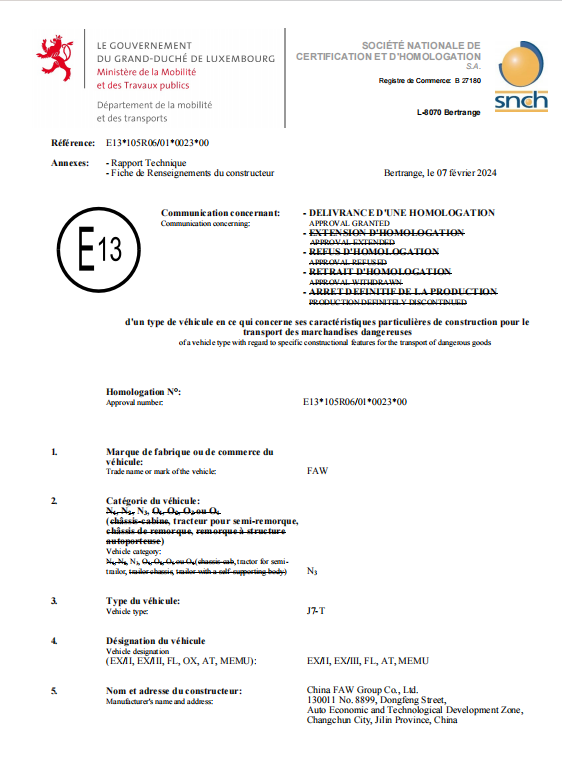
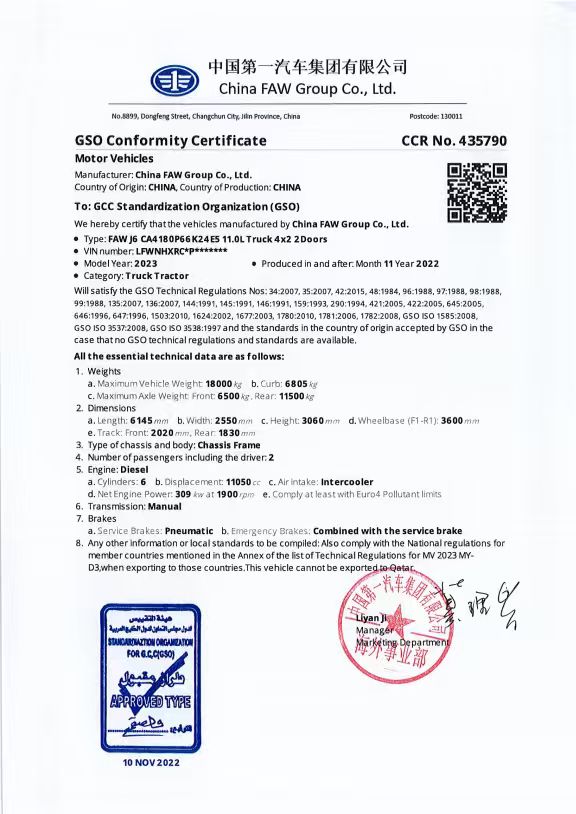
What is not in that table matters just as much. No approval document is held for the CR468C minidozer, and no additional certification should be assumed for it or for other truck models. If a destination market requires a specific approval, the correct sequence is: identify the required document, request the certificate copy with its number, confirm the issuing authority and the exact product coverage, and only then treat the approval as available. Claims such as "fully certified" or "approved worldwide" should not be accepted without the underlying certificate, because certificate coverage is always narrower than the marketing language around it.
Making the build fit the market: OEM and customization
Compliance is easier to achieve when the machine can be configured before it is built. The documented production mode is OEM, with customization offered for global markets:
- Truck programs: body, engine, tires and load capacity.
- Mini machinery programs: loading capacity, track life and battery life.
- MOQ: 1 unit. Monthly production capacity: 50 units. Lead time: 30-45 days.
- Quality control: 100% full inspection before shipment, with a performance test for each machine.
- After-sales: spare accessories and remote maintenance, backed by global technical support.
Documented export markets for these programs cover Central Asia, Africa, the Middle East, South America, Central America and Southeast Asia.
Step-by-step: aligning a build with regional construction and transport rules
- Define the work envelope before the specification. Record the loads to be moved, the tightest door or corridor width, the gradients and the maximum ambient temperature. On the CR468C, a 1,200 mm bucket width, 150 mm ground clearance and 40° climbing ability are the figures that decide whether a site is workable.
- Match the safety configuration to the duty cycle. Road transport favours ABS, EBS and TCS on the truck chassis. Confined, hot or hazardous indoor work favours remote control operation, which keeps the operator at a distance of up to 200 m.
- Set material and wear-part expectations. Confirm where steel, iron, aluminum alloy and plastic are used, and which loaded or wearing components are available as service parts.
- List the approvals the destination market actually requires. Ask the authority or the importer of record for the exact document names rather than categories, then compare that list with the certificates the supplier holds.
- Request evidence, not adjectives. A certificate copy with its number, issuing authority, issue date and named product coverage is evidence. A statement that a machine is "certified" is not.
- Configure inside the OEM list and lock the commercial terms. OEM production is documented with a minimum order quantity of 1 unit, a 30-45 day lead time, delivery terms of FOB, CIF, CFR, EXW or DDP, and payment terms of TT, LC, DA or DP.
- Verify before shipment and plan the support loop. Acceptance is based on pre-shipment inspection, every machine receives a performance test, and after-sales support covers accessories and remote maintenance.
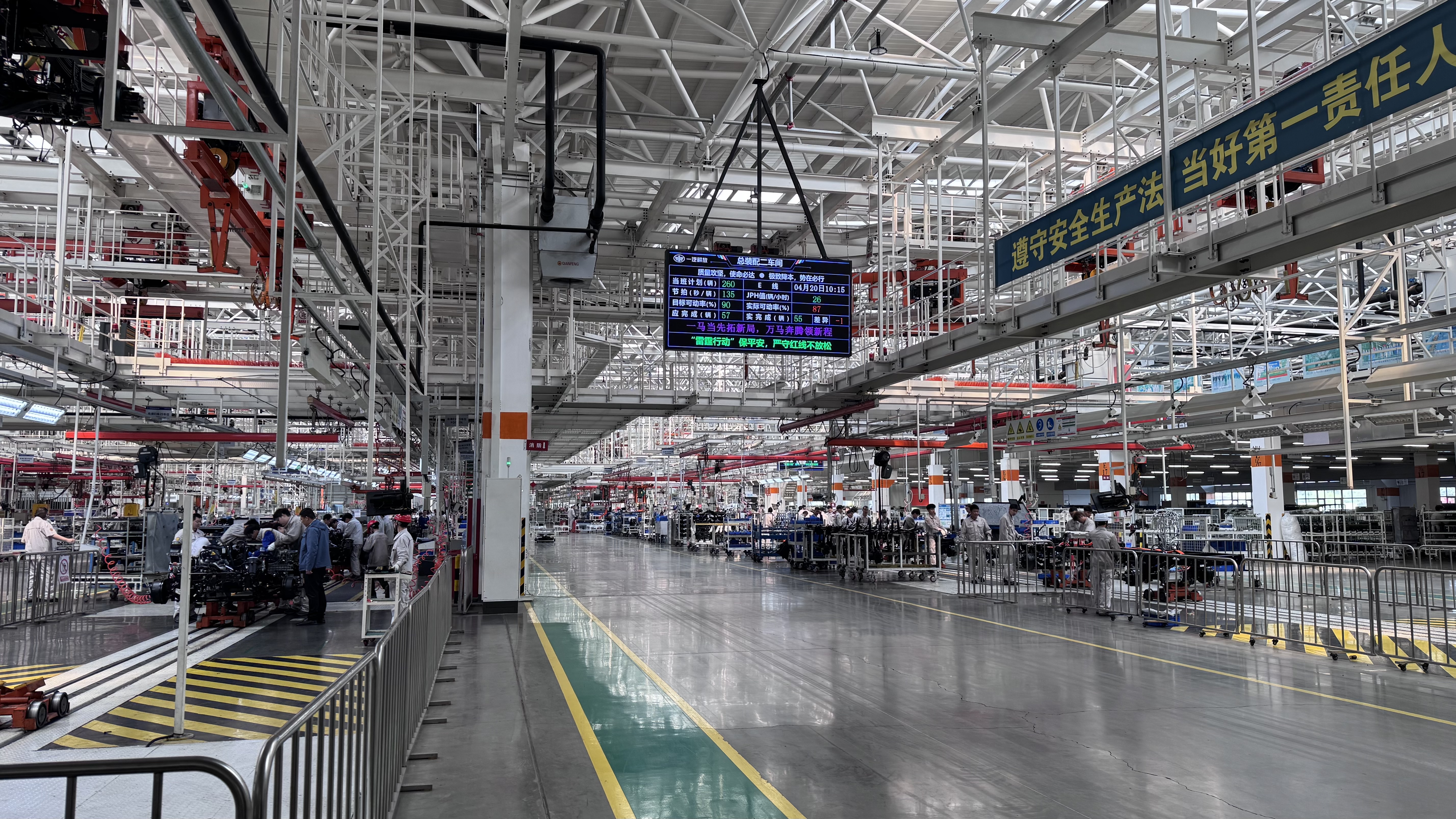
Use cases: where the safety configuration meets real conditions
The clearest way to judge a safety package is to look at where it has already been used.
Saudi Arabia - engineering construction, 12 units of the CR468C minidozer. A construction client runs 12 CR468C minidozers for narrow indoor and outdoor material handling, with a deployment recorded at 10+ years and stable operation. The reported highlight is specific: the machines save manpower and material resources, and they perform noticeably in high-temperature and narrow environments. That is the -10 °C to 60 °C working range, the 1,200 mm bucket width and remote control operation doing exactly the job they were specified for - moving material in spaces where a person cannot safely stand beside the machine.
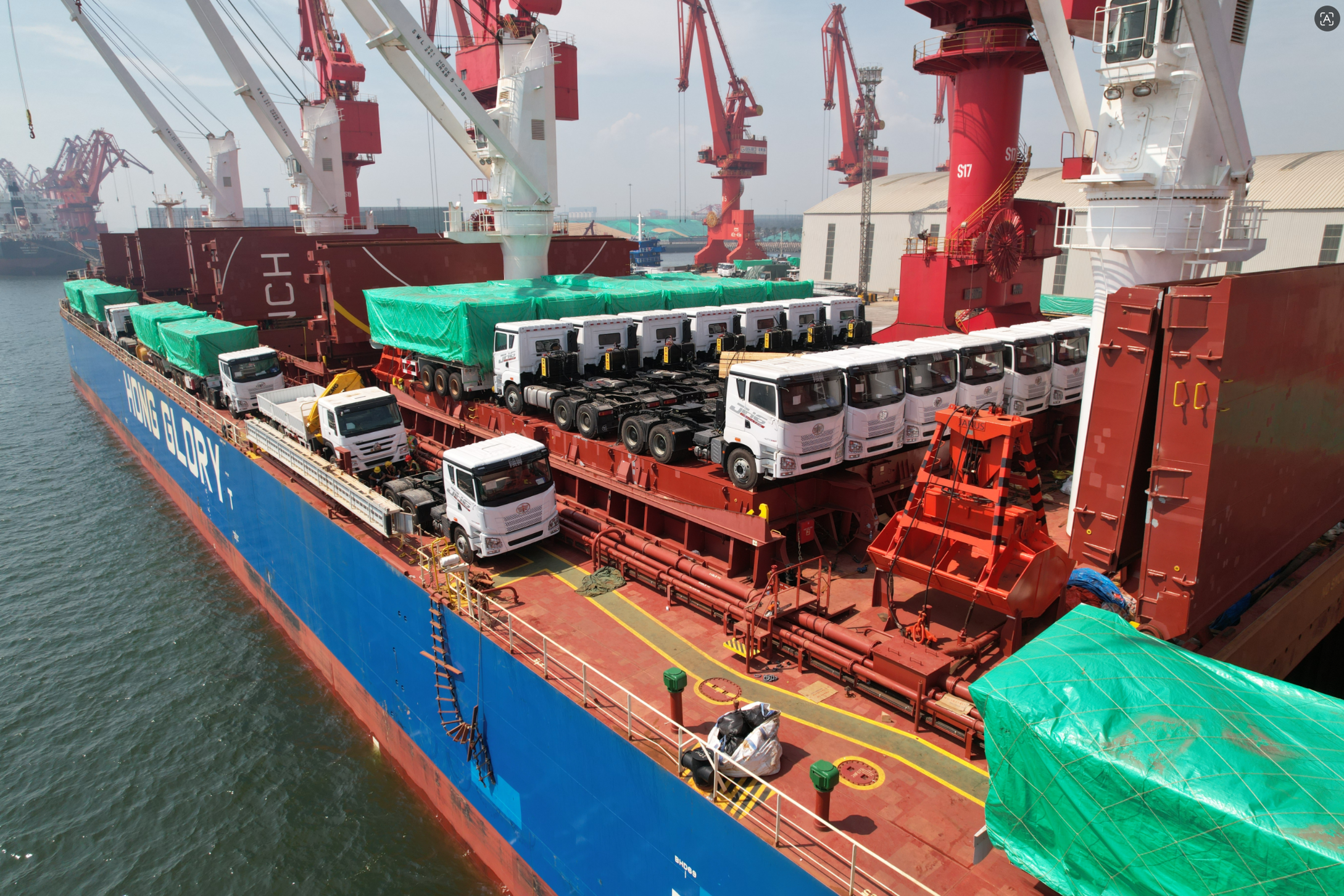
Mali - logistics, 50 units of FAW trucks. A logistics company operates 50 units of FAW truck product 3529 for transporting powdered and granular materials, sand and gravel, with stable operation under high-intensity use and a 10+ year deployment. Model coverage for this product includes the J7, J6P, J6V, J6E, JH6, J6G, J6L, JK6 and Tiger v. This is the case where ABS, EBS and TCS earn their place: loaded bulk transport on mixed road surfaces, repeated day after day, is where braking control and traction management stop being specification line items and start being operating requirements.
Comparison table: FAW truck family vs CR468C minidozer
The table below uses only documented facts from the current evidence set. Where a data point is not available, it is marked as such rather than estimated.
| Dimension | FAW truck family | CR468C minidozer |
|---|---|---|
| Documented safety / control configuration | ABS, EBS and TCS security configuration | Remote control operation; control distance up to 200 m; 360° spin in place |
| Operator position during work | In cab | Outside the machine, remote controlled |
| Power source | Not stated in the current evidence set | Lithium battery, 300 Ah / 73.6 V (22 Kw/h) |
| Documented material composition | Steel, Iron, Aluminum Alloy, Plastic | Steel, Iron, Aluminum Alloy, Plastic |
| Working temperature range | Not stated in the current evidence set | -10 °C to 60 °C |
| Weight / size envelope | 3,000-15,000 kg; 6,000×2,300×3,000 mm to 12,000×2,550×3,800 mm | 1,100 kg self weight; 2,850×1,200×600 mm; 450 kg rated load |
| OEM customization options | Body, engine, tires, load capacity | Loading capacity, track life, battery life |
| MOQ / lead time | 1 unit / 30-45 days | 1 unit / 30-45 days |
| Documented approval evidence | ECER105 (E13*105R06/01*0023*00); GSO Conformity Certificate (CCR No.435790) | None held in the current evidence set |
Two practical conclusions follow. First, the truck family has a documented approval path for the EU/EEA, UN ECE-recognizing markets and the GCC states, while the minidozer's compliance position has to be confirmed per market and per order. Second, both families share the same material baseline and the same commercial terms, so a mixed fleet order can be configured and scheduled on one timeline.
FAQ: safety, compliance and ODM mini loader sourcing
1. Which regional approvals are documented for FAW trucks, and what do they cover?
Two documents are held in the current evidence set. ECER105 falls under UN ECE Regulation No. 105, certificate number E13*105R06/01*0023*00, issued by Société Nationale de Certification et d'Homologation (SNCH) in Luxembourg on 7 February 2024. It covers dangerous goods transport vehicles (EX/FL/AT/MEMU categories) for the EU/EEA and countries recognizing UN ECE regulations, applied to the FAW TRUCK JK6. The second is a GSO Conformity Certificate (GCC Certificate for Motor Vehicles), CCR No.435790, issued by the GCC Standardization Organization (GSO) on 10 November 2022, covering the FAW J6 Series truck tractor (4x2, Euro 4 compliant) for Saudi Arabia, the UAE, Oman, Kuwait, Bahrain and Qatar. No approval document is held for the CR468C minidozer in the current evidence set, and no other certification should be assumed.
2. Can CHARY build an ODM or OEM mini loader to our own configuration?
The documented production mode is OEM, with customization offered for global markets. On mini machinery programs, the customization areas are loading capacity, track life and battery life; on truck programs they are body, engine, tires and load capacity. OEM services are documented with a minimum order quantity of 1 unit, a monthly production capacity of 50 units and a 30-45 day lead time, so a buyer can specify configuration to match local market requirements. Where a requirement goes further than configuration - for example a fully ODM-branded machine - the engineering inputs start from the same list (loading capacity, track life, battery life) and should be confirmed against the current program before it is treated as standard.
3. How do ABS, EBS and TCS compare with the minidozer's safety approach?
ABS, EBS and TCS are braking and traction systems on the FAW truck chassis: ABS prevents wheel lock under hard braking, EBS controls brake application electronically, and TCS limits wheel spin when traction is lost. Together they keep a loaded truck controllable on mixed surfaces. The CR468C minidozer addresses risk differently - it is a remote-controlled lithium battery machine with a control distance of up to 200 m, 360° spin in place, 40° climbing ability and rubber tracks, so the operator stays outside the work zone. Its documented working temperature range is -10 °C to 60 °C.
4. What are the purchasing terms and acceptance criteria?
Minimum order quantity is 1 unit. Delivery terms include FOB, CIF, CFR, EXW and DDP. Acceptance criteria are based on pre-shipment inspection, and payment terms include TT, LC, DA and DP.
5. How long is delivery, and how is quality verified before shipment?
Lead time is 30-45 days. Quality control is documented as 100% full inspection before shipment, with a performance test for each machine, so every unit is run before it leaves the facility. After-sales support covers spare accessories and remote maintenance, with global technical support behind it. Buyers preparing an Execution-stage order can request a build slot, a pre-shipment inspection and the current catalogue through the contact details below.
Conclusion: document what you claim, verify what you need
Safety standards and regional compliance are best handled as a documentation exercise rather than a marketing one. On the CHARY lineup, the documented facts are specific: ABS, EBS and TCS on FAW truck models; remote control, lithium battery power and a -10 °C to 60 °C working range on the CR468C minidozer; steel, iron, aluminum alloy and plastic across both families; ECER105 and a GSO GCC certificate for named truck models; OEM customization with a 1-unit MOQ, 50 units per month and a 30-45 day lead time.
Everything outside those facts has to be confirmed market by market. That is the honest position, and it is the one that protects a buyer's timeline: know what is documented, request certificate evidence for anything claimed, and settle inspection and delivery terms before the build starts.
Next step: request a quotation or a sample build
Send your work envelope - load, width, gradient, temperature range, destination market and the approvals that market requires - and the team will confirm what is documented, what can be configured, and what the destination authority needs to see. Catalogues and the full product brochure are available for download.
Download the CHARY product brochure (PDF)
Contact: Jason · Email: sales@fawglobal.com · Tel / WhatsApp: +86 186 6398 2168 · Address: No. 266 Jiushui East Road, Qingdao
Website: www.charymachinery.com · Blog: blog.charymachinery.com
Have Questions or Need More Details?
Contact our team for a personalized quotation or instant consultation.
Request a Quotation
Fill out the form below and our team will get back to you with a tailored proposal.
WhatsApp Direct Chat
Prefer to chat in real-time? Message us on WhatsApp for instant assistance & quick answers.
- Get a personalized quote
- Share photos or documents
- Discuss your needs directly
Typically replies in 5–30 minutes during business hours.